<feed xmlns="http://www.w3.org/2005/Atom">
  <title>Species: Common Murre</title>
	<subtitle>Nature, wildlife, and bird photography by Sarah Fossheim 🌿</subtitle>
	<link href="https://fossheim.photography/species/"/>
  <link href="https://fossheim.photography/species/uriaAalge/feed.xml" rel="self"/>
  <updated>2025-02-05T00:00:00.000Z</updated>
  <id>https://fossheim.photography/species/uriaAalge</id>
  <author>
    <name>Sarah L. Fossheim</name>
    <email>hi@fossheim.photography</email>
	</author>

  
    <entry>
      <title>blog: About the beautiful bridled common murres.</title>
      
        <link href="https://fossheim.photography/blog/bridled-common-murre-fun-facts" />
      
      <updated>2024-09-03T00:00:00.000Z</updated>
      
      
        <id>https://fossheim.photography/blog/bridled-common-murre-fun-facts</id>
      
      <content type="html"><![CDATA[
          
            
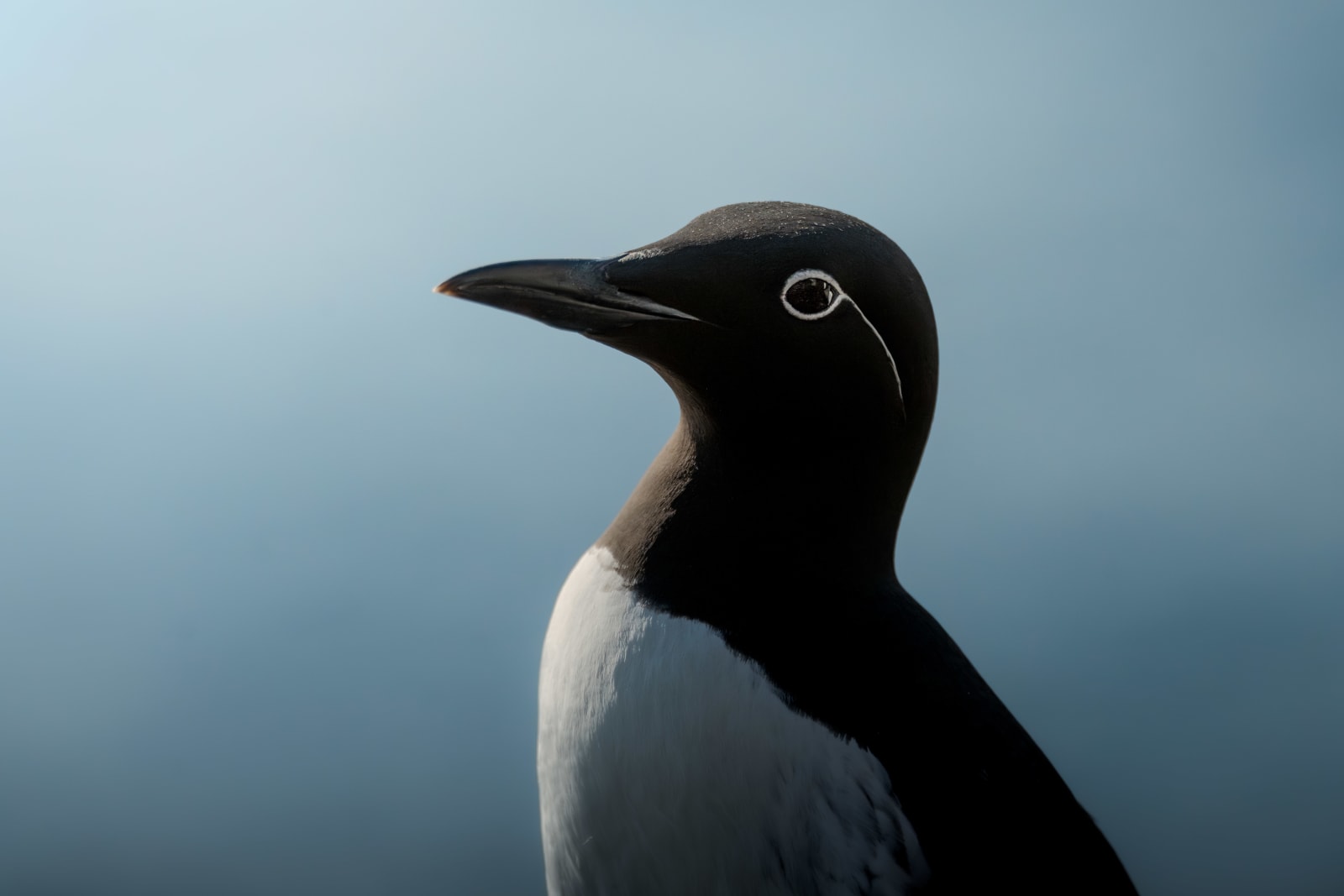
            <img src="https://res.cloudinary.com/dy8r02i02/image/upload/f_auto,w_1900,c_scale/ringvi-hornøya" alt="Portrait of a bridled common murre standing in front of a teal/blue blurry background (out of focus ocean), photographed from the chest up. The belly is white, the back and head are very dark brown (but look black), medium-sized sharp gray beak. Around its eye is a white circle and line, resembling glsses. The bird eye is in focus, along with tiny water droplets on top of the head. Light cimes from the left behind of the murre." />
          
          
            <p>It’s no secret that murres are my favorite birds. I fell in love with the thick-billed murres (Uria lomvia) while in Svalbard in 2017, and they’re the birds that sort of got me into birding. Since then I’ve gotten to know the common murres (Uria aalge) a lot better as well, which are more common on mainland Norway.</p>
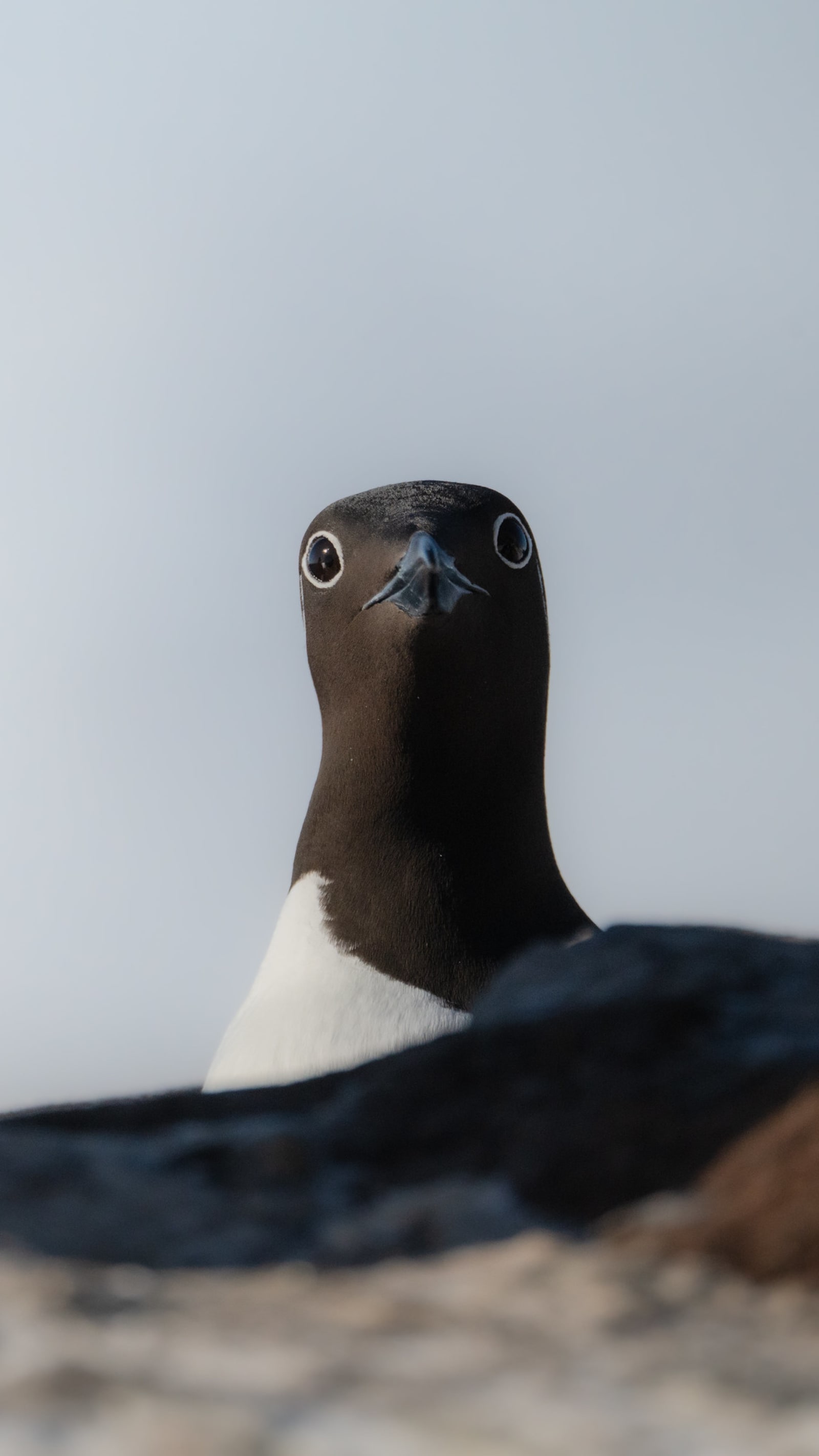
<p>This year I visited them several times at Hornøya, where around a third of the common murres are of the bridled variation (in Norwegian sometimes called <em>ringvi</em> instead of <em>lomvi</em>), which have a white ring and band resembling glasses around the eyes.</p>

          
          <div class="size-m">
  <div class="container">
<p><a href="/photos/catalog/2024-06-19-hornoya/ringvi-1/"></p>
  <img class="main-image" src="https://res.cloudinary.com/dy8r02i02/image/upload/f_auto,w_1900,c_scale/ringvi-hornøya" alt="Portrait of a bridled common murre standing in front of a teal/blue blurry background (out of focus ocean), photographed from the chest up. The belly is white, the back and head are very dark brown (but look black), medium-sized sharp gray beak. Around its eye is a white circle and line, resembling glsses. The bird eye is in focus, along with tiny water droplets on top of the head. Light cimes from the left behind of the murre." />
<p></a></p>
</div>
</div>
<div class="size-s container">
<h2>1) Bridled common murres are not a different species or subspecies</h2>
<p>Bridled common murres are the same species as the “regular” (non-bridled) common murres, the ring is is just a variation in looks.</p>
<h2>2) They’re only found found along the Atlantic coast</h2>
<p>The bridled variation is only found along the Atlantic coast, so Europe and East-coast America. Common murres also breed in the Pacific Ocean (from the gulf of Alaska until California), but the bridled variation is generally not found there. In 2008 researchers observed one bridled common murre in central California.</p>
<p>It’s not clear however if this variation naturally (but just very very rarely) occurs in common murres breeding in the Pacific area as well, or if the observed individuals were just lost Atlantic-ocean murres.</p>
<p>Read more about this:</p>
<ul>
<li><a href="https://archive.westernfieldornithologists.org/archive/V42/WB-V42-1-Schmidt.pdf">First record of the bridled morph of the common murre in the Pacific</a></li>
</ul>
</div>
<div class="size-m">
  <div class="container">
<p><a href="/photos/catalog/2024-06-19-hornoya/lomvi-bokeh/"></p>
  <img class="main-image" src="https://res.cloudinary.com/dy8r02i02/image/upload/f_auto,w_1900,c_scale/lomvi-bokeh_jbjcbl" alt="Common murre silhouette (chest upwards), with a blue sea full of blurry bokeh in the background." />
<p></a></p>
</div>
</div>
<div class="size-s container">
<h2>3) They’re more common in the north</h2>
<p>Bridled common murres are more common in northern regions than they are the south. Some colonies in Portugal are exclusively non-bridled, and by Bjørnøya (Svalbard) half the common murre population has glasses. At Hornøya around one third are bridled.</p>
<p>Read more about this:</p>
<ul>
<li><a href="https://www.researchgate.net/publication/229929553_Distribution_of_the_bridled_form_of_the_Common_Guillemot_Uria_aalge_in_the_North_Atlantic">Distribution of the bridled form of the Common guillemot Uria aalge in the North Atlantic</a></li>
<li><a href="https://www.researchgate.net/publication/229990607_Quantitative_Studies_in_the_Geographical_Variation_of_Birds-_The_Common_Guillemot_Uria_aalge_Pont">Quantitative Studies in the Geographical Variation of Birds – The Common Guillemot (Uria aalge)</a></li>
</ul>
<h2>4) They thrive better in colder temperatures</h2>
<p>Bridled common murres seem to be better adapted for cold temperatures. Research showed that mortality amongst bridled common murres was highest after winters with higher temperatures of sea water. This could also explain why they’re more common in northern regions.</p>
<p>Read more about this:</p>
<ul>
<li><a href="https://esajournals.onlinelibrary.wiley.com/doi/10.1890/ES12-00031R">Climate fluctuations and differential survival of bridled and non-bridled Common Guillemots Uria aalge</a></li>
</ul>
</div>
<div class="size-l">
<div class="collection-photos container size-l">
<div class="collection-grid" data-stretch="" data-size="" data-type="large" data-alignment="center" data-shape="normal" data-stretch="">
<div>
<a href="/photos/catalog/2024-04-09-varanger/lomvi-couple/">
<img class="main-image" src="https://res.cloudinary.com/dy8r02i02/image/upload/f_auto,w_1900,c_scale/lomvi-couple_sdm79m" alt="Telezoom portrait of two common murres cuddling and preening eachother, with murres blurred out in the foreground and background" />
</a>
</div>
<div>
<a href="/photos/catalog/2024-06-03-hornoya/lomvi-group-1/">
<img class="main-image" src="https://res.cloudinary.com/dy8r02i02/image/upload/f_auto,w_1900,c_scale/DSC00953-Enhanced-NR-2-edited_doo4ii" alt="Group of 10-15 murres tightly standing together on the side of a cliff, with the ocean in the background. The two murres in the middle are mounting eachother." />
</a>
</div>
</div>
</div>
</div>
<div class="size-s container">
<h2>5) The combination of parents influences the size of the chicks</h2>
<p>Whether the parents are both bridled, both non-bridled, or mixed seems to play a role in the size of the chicks. Mixed parents, one bridled and one non-bridled, produced larger chicks compared to “pure” bridled and “pure” non-bridled pairs. Bridled common murres were generally the shortest.</p>
<p>Read more about this:</p>
<ul>
<li><a href="https://link.springer.com/article/10.1007/s00265-014-1794-8">Differential breeding investment in bridled and non-bridled common guillemots (Uria aalge): morph of the partner matters</a></li>
</ul>
<p>More murre pictures can be found in my <a href="https://fossheim.photography/species/uriaaalge/">Common Murre / Uria aalge</a> species collection, and <a href="https://shop.fossheim.photography/collections/auks/print">prints can be found in my shop</a>.</p>
</div>

        ]]>
      </content>
    </entry>
  
    <entry>
      <title>photo: Common murre</title>
      
        <link href="https://fossheim.photography/photos/catalog/2024-06-19-hornoya/lomvi-group" />
      
      <updated>2024-06-14T00:00:00.000Z</updated>
      
      
        <id>https://fossheim.photography/photos/catalog/2024-06-19-hornoya/lomvi-group"</id>
      
      <content type="html"><![CDATA[
          
            <img src="https://res.cloudinary.com/dy8r02i02/image/upload/f_auto,w_1900,c_scale/DSC02981-Enhanced-NR-2-3_rrkamr" alt="Group of ca 15 common murres standing closely together on a sunny day. The picture is taken with a telezoom lens, showing them all chest up, focused on two cuddling murres in the middle." />
          
          
            <p>Group of common murres at Hornøya.</p>
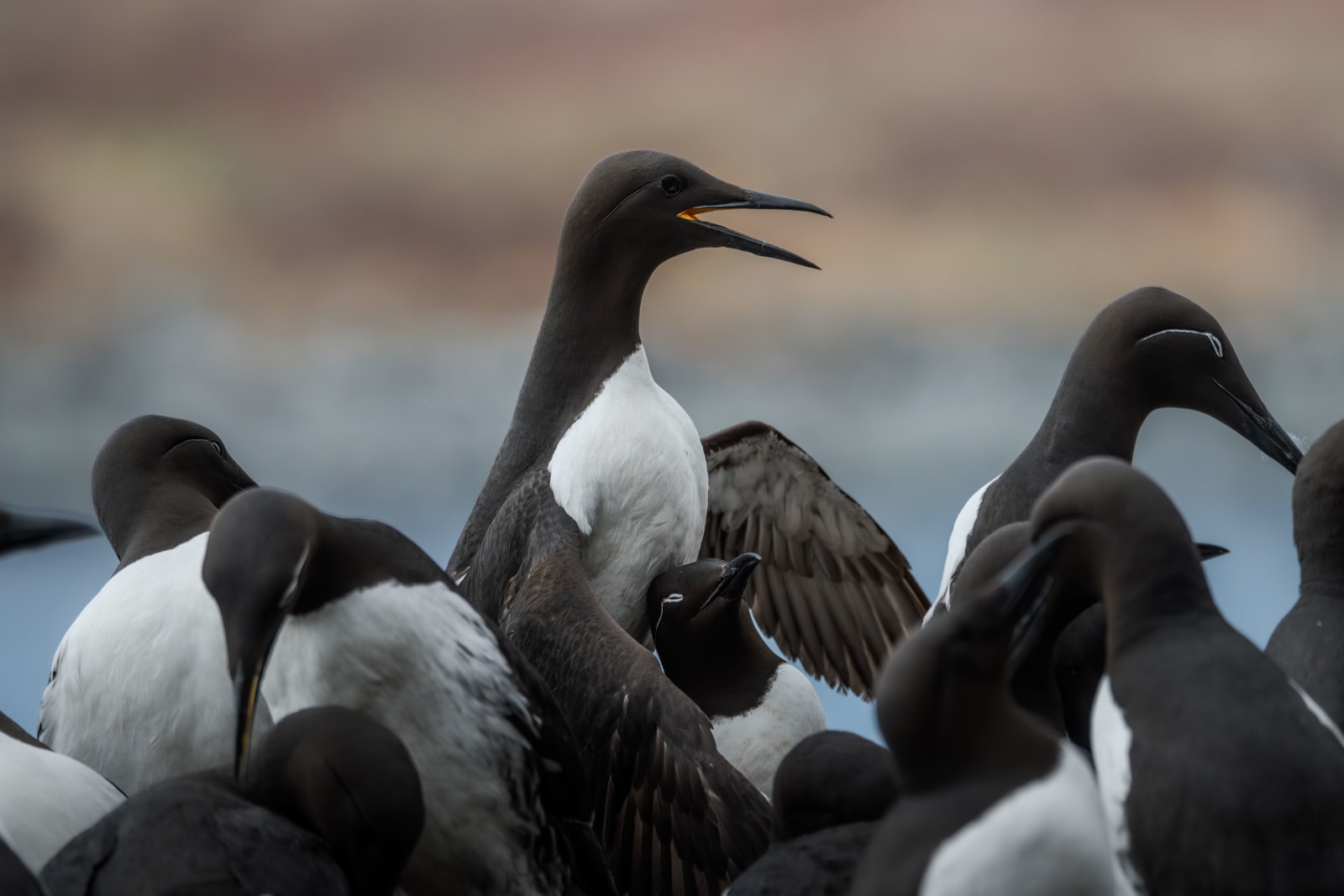
<p>Murres are very social auks, that breed as tight as 20 pairs (40 individuals) per square meter. Being so close together offers better protection to the eggs and chicks, since neighbors can assist in fighting off predators.</p>
<p>Being this tight to your neighbor is guaranteed to to cause some commotion, and we observed many murres both cozing up to their neighbors, and getting into friendly arguments with them.</p>


        ]]>
      </content>
    </entry>
  
    <entry>
      <title>photo: Bridled Common Murre at Hornøya</title>
      
        <link href="https://fossheim.photography/photos/catalog/2024-06-19-hornoya/ringvi-1" />
      
      <updated>2024-06-14T00:00:00.000Z</updated>
      
      
        <id>https://fossheim.photography/photos/catalog/2024-06-19-hornoya/ringvi-1"</id>
      
      <content type="html"><![CDATA[
          
            <img src="https://res.cloudinary.com/dy8r02i02/image/upload/f_auto,w_1900,c_scale/ringvi-hornøya" alt="Portrait of a bridled common murre standing in front of a teal/blue blurry background (out of focus ocean), photographed from the chest up. The belly is white, the back and head are very dark brown (but look black), medium-sized sharp gray beak. Around its eye is a white circle and line, resembling glsses. The bird eye is in focus, along with tiny water droplets on top of the head. Light cimes from the left behind of the murre." />
          
          
            <p>Bridled common murre portrait, taken at Hornøya (in Finnmark, Norway). In Norwegian this variation of murre is often called a &quot;ringvi&quot;, merging the words &quot;ring&quot; and &quot;lomvi&quot; (murre).</p>
<p>The birds at Hornøya are not shy, and often running over the path and between people at Hornøya, actively checking out what the humans are up to. This one was standing a few meters away from me, overlooking the ocean.</p>
<p>This picture is available as <a href="https://shop.fossheim.photography/products/common-murre-portrait-hornoya">a print</a>, <a href="https://shop.fossheim.photography/products/bridled-common-murre-hornoya-spiral-notebook">notebook</a>, or <a href="https://shop.fossheim.photography/products/bridled-common-murre-white-glossy-mug">mug</a>.</p>

          
          <div class="size-full container content-light content-padded">
  <div class="container size-s">
<p><h2>About the bridled common murre</h2></p>
<p>Common murres come in two variants: Either their had is completely black (this is the most common), or with a white ring around the eyes. These are the same species, uria aalge, but they do have a few minor differences.</p>
<p>Bridled common murres are <a href="https://zslpublications.onlinelibrary.wiley.com/doi/10.1111/j.1469-7998.1984.tb05949.x">more common in the north compared to the south</a>. In some murre colonies in Portugal there are no bridled variants at all, while at Bjørnøya closer to Svalbard around half of them wear glasses. Bridled common murres are better adapted to the cold, and researchers have found that <a href="https://esajournals.onlinelibrary.wiley.com/doi/full/10.1890/ES12-00031R">mortality amongst them is higher when winters are warner</a>.</p>
<p><a href="https://link.springer.com/article/10.1007/s00265-014-1794-8">Whether the parents are both bridled, both non-bridled, or mixed seems to play a role in the size of the chicks</a>. This could indicate a difference in behavior or feeding tactic between both variations.</p>
  </div>
</div>
<div class="container size-l accent-headlines">
  <h2 class="text-center">More bridled common murre pictures</h2>
<div class="collection-photos container size-l">
<div class="collection-grid" data-stretch="" data-size="" data-type="medium" data-alignment="center" data-shape="normal" data-stretch="">
<div>
<a href="/photos/catalog/2024-06-19-hornoya/lomvi-bokeh/">
<img class="main-image" src="https://res.cloudinary.com/dy8r02i02/image/upload/f_auto,w_1900,c_scale/lomvi-bokeh_jbjcbl" alt="Common murre silhouette (chest upwards), with a blue sea full of blurry bokeh in the background." />
</a>
</div>
<div>
<a href="/photos/catalog/2024-04-09-varanger/lomvi-couple/">
<img class="main-image" src="https://res.cloudinary.com/dy8r02i02/image/upload/f_auto,w_1900,c_scale/lomvi-couple_sdm79m" alt="Telezoom portrait of two common murres cuddling and preening eachother, with murres blurred out in the foreground and background" />
</a>
</div>
<div>
<a href="/photos/catalog/2024-04-09-varanger/murre-portrait/">
<img class="main-image" src="https://res.cloudinary.com/dy8r02i02/image/upload/f_auto,w_1900,c_scale/murre-portrait-varanger_k4rjjj" alt="Telezoom portrait of a common murre, with out-of-focud rocks in the foreground. The myrre has a black head with black beak, and white &quot;glasses&quot; around the eyes, and is looking straight at the camera" />
</a>
</div>
</div>
</div>
  <p class="all">
    <a href="/species/uriaAalge/photos/">
      View all my common murre photos
    </a>
  </p>
</div>
        ]]>
      </content>
    </entry>
  
    <entry>
      <title>photo: Common murre</title>
      
        <link href="https://fossheim.photography/photos/catalog/2024-06-19-hornoya/lomvi-bokeh" />
      
      <updated>2024-06-14T00:00:00.000Z</updated>
      
      
        <id>https://fossheim.photography/photos/catalog/2024-06-19-hornoya/lomvi-bokeh"</id>
      
      <content type="html"><![CDATA[
          
            <img src="https://res.cloudinary.com/dy8r02i02/image/upload/f_auto,w_1900,c_scale/lomvi-bokeh_jbjcbl" alt="Common murre silhouette (chest upwards), with a blue sea full of blurry bokeh in the background." />
          
          
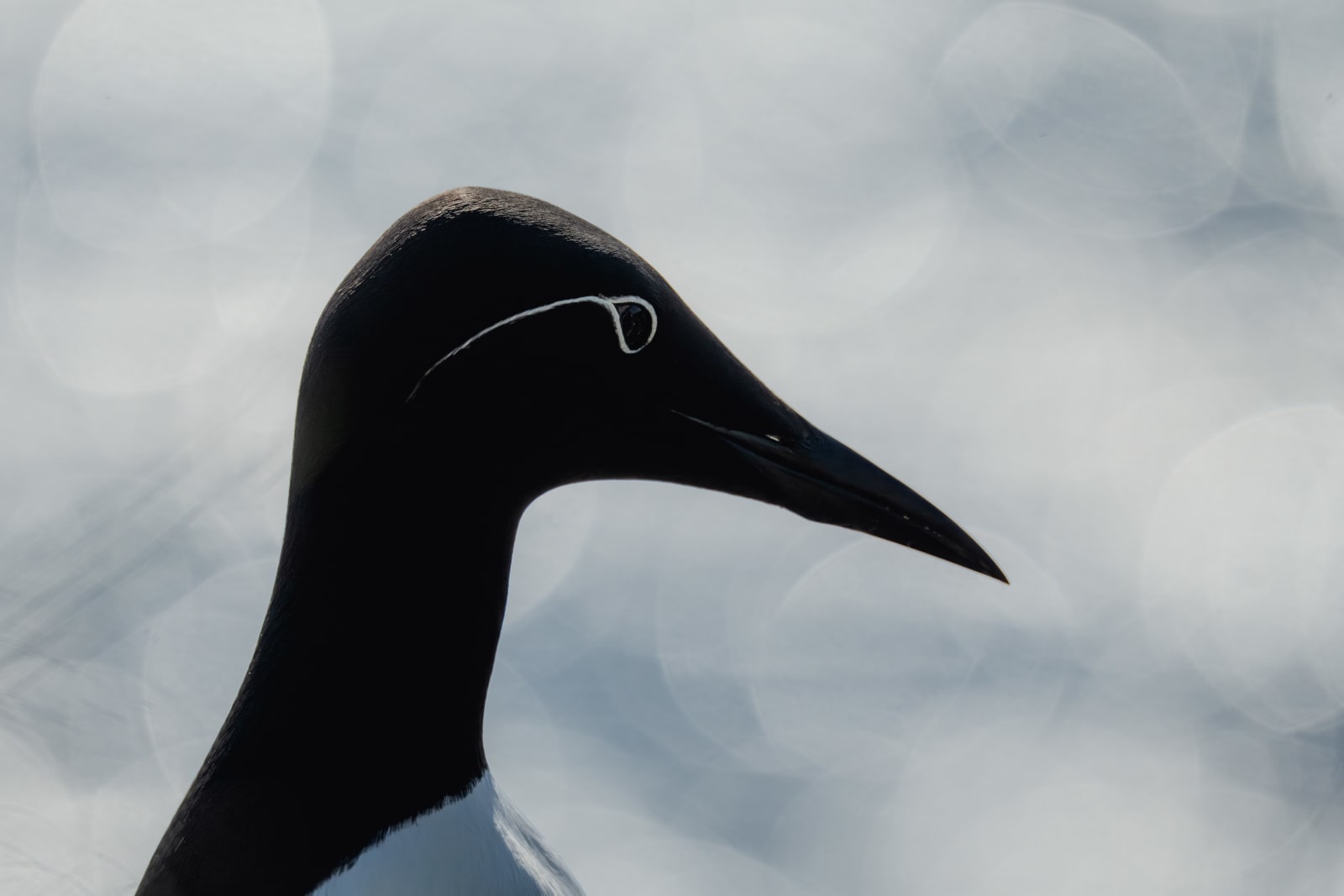
            <p>Common murre overlooking the sea.</p>


        ]]>
      </content>
    </entry>
  
    <entry>
      <title>photo: Common murre</title>
      
        <link href="https://fossheim.photography/photos/catalog/2024-06-03-hornoya/lomvi-portrait-1" />
      
      <updated>2024-06-03T00:00:00.000Z</updated>
      
      
        <id>https://fossheim.photography/photos/catalog/2024-06-03-hornoya/lomvi-portrait-1"</id>
      
      <content type="html"><![CDATA[
          
            <img src="https://res.cloudinary.com/dy8r02i02/image/upload/f_auto,w_1900,c_scale/DSC00919-Enhanced-NR-1-edited_zgpc5o" alt="Portrait of a common murre. In the foreground there&#39;s a muddy hill, and behind the main murre there&#39;s another one that&#39;s out of focus." />
          
          
            <p>Common murre at Hornøya.</p>


        ]]>
      </content>
    </entry>
  
    <entry>
      <title>photo: Common murre portrait</title>
      
        <link href="https://fossheim.photography/photos/catalog/2024-06-03-hornoya/lomvi-portrait-2" />
      
      <updated>2024-06-03T00:00:00.000Z</updated>
      
      
        <id>https://fossheim.photography/photos/catalog/2024-06-03-hornoya/lomvi-portrait-2"</id>
      
      <content type="html"><![CDATA[
          
            <img src="https://res.cloudinary.com/dy8r02i02/image/upload/f_auto,w_1900,c_scale/DSC01583-Enhanced-NR-2_pofahk" alt="Portrait of a bridled common murre. In the foreground there&#39;s a green out of focus mossy rock, the background is the out  of focus ocean." />
          
          
            <p>Common murre at Hornøya (northern Norway). Here around 100,000 seabirds breed each summer season, and the murres are the most numerous species on the island, with over 15,000 breeding pairs.</p>
<p>This individual was hanging out with the shags, and taking a peek from behind a rock right next to the shoreline.</p>


        ]]>
      </content>
    </entry>
  
    <entry>
      <title>photo: Common murre</title>
      
        <link href="https://fossheim.photography/photos/catalog/2024-06-03-hornoya/lomvi-group-1" />
      
      <updated>2024-06-03T00:00:00.000Z</updated>
      
      
        <id>https://fossheim.photography/photos/catalog/2024-06-03-hornoya/lomvi-group-1"</id>
      
      <content type="html"><![CDATA[
          
            <img src="https://res.cloudinary.com/dy8r02i02/image/upload/f_auto,w_1900,c_scale/DSC00953-Enhanced-NR-2-edited_doo4ii" alt="Group of 10-15 murres tightly standing together on the side of a cliff, with the ocean in the background. The two murres in the middle are mounting eachother." />
          
          
            <p>Common murres creating a new generation while their friends and family watch. Murres nest very close to eachother, which offers protection from predators, and it's often family that they nest next to. No privacy at all.</p>


        ]]>
      </content>
    </entry>
  
    <entry>
      <title>photo: Common murres in Hvaler</title>
      
        <link href="https://fossheim.photography/photos/catalog/2024-05-18-murrelease/release-1" />
      
      <updated>2024-05-18T00:00:00.000Z</updated>
      
      
        <id>https://fossheim.photography/photos/catalog/2024-05-18-murrelease/release-1"</id>
      
      <content type="html"><![CDATA[
          
            <img src="https://res.cloudinary.com/dy8r02i02/image/upload/f_auto,w_1900,c_scale/murre-water-1_cw6ubo" alt="Two young murres on the water" />


        ]]>
      </content>
    </entry>
  
    <entry>
      <title>photo: Common Murre  @ Hornøya</title>
      
        <link href="https://fossheim.photography/photos/catalog/2024-04-09-varanger/murre-portrait" />
      
      <updated>2024-04-09T00:00:00.000Z</updated>
      
      
        <id>https://fossheim.photography/photos/catalog/2024-04-09-varanger/murre-portrait"</id>
      
      <content type="html"><![CDATA[
          
            <img src="https://res.cloudinary.com/dy8r02i02/image/upload/f_auto,w_1900,c_scale/murre-portrait-varanger_k4rjjj" alt="Telezoom portrait of a common murre, with out-of-focud rocks in the foreground. The myrre has a black head with black beak, and white &quot;glasses&quot; around the eyes, and is looking straight at the camera" />
          
          
            <p>Common murre photographed at Hornøya, an island in the northernmost and easternmost part of Norway.</p>
<p>Murres spend the majority of their life at sea, and only come on land to breed, which happens on steep seaside cliffs like these. This picture was taken at the start of April, when the seabirds had just returned to their nesting grounds.</p>
<p>This is the bridled version, in Norwegian also called &quot;ringvi&quot; (<em>ring-lomvi</em>), which has a white circle around the eyes that makes them look as if they're wearing glasses.</p>
<p>I thought this one individual looked particularly cute, checking me out from behind a rock. They're curious and <em>very</em> lively and social birds, it's so fun to observe.</p>


        ]]>
      </content>
    </entry>
  
    <entry>
      <title>photo: Common Murre  @ Hornøya</title>
      
        <link href="https://fossheim.photography/photos/catalog/2024-04-09-varanger/auks-in-flight" />
      
      <updated>2024-04-07T00:00:00.000Z</updated>
      
      
        <id>https://fossheim.photography/photos/catalog/2024-04-09-varanger/auks-in-flight"</id>
      
      <content type="html"><![CDATA[
          
            <img src="https://res.cloudinary.com/dy8r02i02/image/upload/f_auto,w_1900,c_scale/Auks_In_Flight_Hornøya_gki1tb" alt="Hundereds of auks, mainly common murres (and a handful of puffins, razorbills, and gulls), flying past the camera. It&#39;s a blue sky with light clouds in the background, and the picture is taken with a telezoom lens, causing the birds in the foreground and background to be slightly in movement and out of focus." />
          
          
            <p>When birds of prey fly past, all the auks instantly abandon their cliff, leading to a lot of <em>chaotic</em> sights like this one.</p>
<p>While I was on the island, the birds on the cliff flew off like this several times. And while it looked and sounded very chaotic (I mean, it's literally thousands of seabirds shouting and flying away in the sme direction, of course it's chaotic), they did seem quite synchronized and disciplined, and collisions are rare.</p>


        ]]>
      </content>
    </entry>
  
    <entry>
      <title>photo: Bridled common Murre at Hornøya</title>
      
        <link href="https://fossheim.photography/photos/catalog/2024/2024-04-07-hornoya/murre-snow-1" />
      
      <updated>2024-04-07T00:00:00.000Z</updated>
      
      
        <id>https://fossheim.photography/photos/catalog/2024/2024-04-07-hornoya/murre-snow-1"</id>
      
      <content type="html"><![CDATA[
          
            <img src="https://res.cloudinary.com/dy8r02i02/image/upload/f_auto,w_1900,c_scale/lomvi-snow-mountain" alt="Bridled common murre (with white eye ring) standing in front of a snowed in mountain." />
          
          
            <p>Common murre photographed at Hornøya, April 2024.</p>


        ]]>
      </content>
    </entry>
  
    <entry>
      <title>photo: Photobombing shag</title>
      
        <link href="https://fossheim.photography/photos/catalog/2024/2024-04-07-hornoya/photobombing-shag" />
      
      <updated>2024-04-07T00:00:00.000Z</updated>
      
      
        <id>https://fossheim.photography/photos/catalog/2024/2024-04-07-hornoya/photobombing-shag"</id>
      
      <content type="html"><![CDATA[
          
            <img src="https://res.cloudinary.com/dy8r02i02/image/upload/f_auto,w_1900,c_scale/DSC07604-Enhanced-NR_pcfpnm" alt="Three common guillemots (uria aalge) posing in front of a white snowed in mountain, with more murres/guillemots flying in the background. It almost looks peaceful, except in the foreground a european shag (type of cormorant) is crash landing into the snow, in the most dramatic way possible." />
          
          
            <p>I was taking a picture of this family of common murres/common guillemots (Uria aalge) posing while more auks flew by at Hornøya, when a European Shag (Phalacrocorax aristotelis) crashlanded in the snow right in front of me, creating this dramatic portrait.</p>
<p>Picture taken at Hornøya, by Vardø in the north of Norway.</p>


        ]]>
      </content>
    </entry>
  
    <entry>
      <title>photo: Murre  couple</title>
      
        <link href="https://fossheim.photography/photos/catalog/2024-04-09-varanger/lomvi-couple" />
      
      <updated>2024-04-05T00:00:00.000Z</updated>
      
      
        <id>https://fossheim.photography/photos/catalog/2024-04-09-varanger/lomvi-couple"</id>
      
      <content type="html"><![CDATA[
          
            <img src="https://res.cloudinary.com/dy8r02i02/image/upload/f_auto,w_1900,c_scale/lomvi-couple_sdm79m" alt="Telezoom portrait of two common murres cuddling and preening eachother, with murres blurred out in the foreground and background" />
          
          
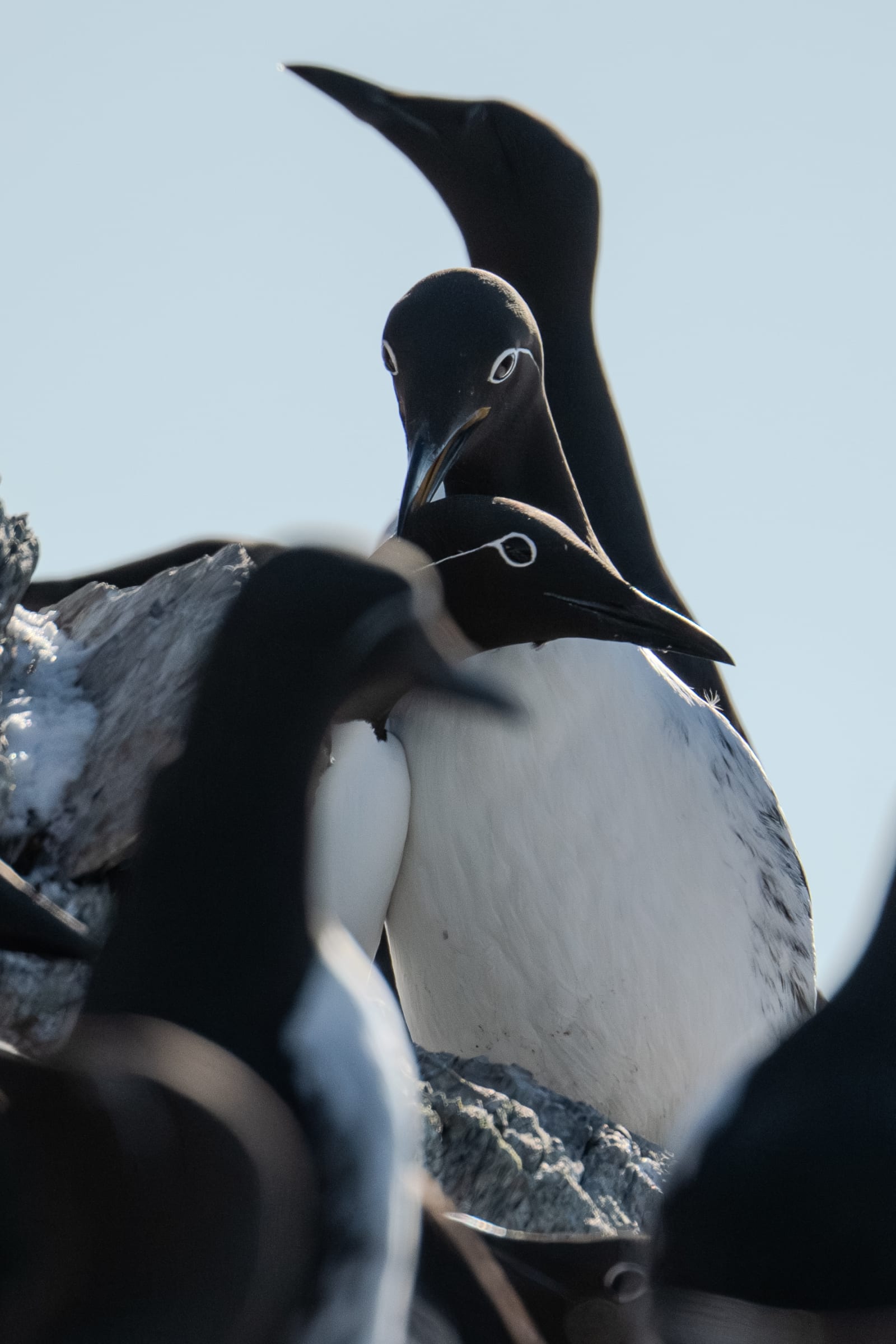
            <p>Two common murres preening eachother at Hornøya, a bird cliff in northern Norway. These are the bridled variation (also called &quot;ringvi&quot; in Norwegian), which have a white stripe around the eyes resembling glasses.</p>
<p>Bridled common murres are the same species (Uria aalge). The glasses are just a genetic variation, and are more common in northern regions.</p>


        ]]>
      </content>
    </entry>
  
    <entry>
      <title>photo: Common murres flying around Hornøya</title>
      
        <link href="https://fossheim.photography/photos/catalog/2024-04-09-varanger/lomvi-flight-2" />
      
      <updated>2024-04-05T00:00:00.000Z</updated>
      
      
        <id>https://fossheim.photography/photos/catalog/2024-04-09-varanger/lomvi-flight-2"</id>
      
      <content type="html"><![CDATA[
          
            <img src="https://res.cloudinary.com/dy8r02i02/image/upload/f_auto,w_1900,c_scale/murre-flight_fy4s2a" alt="Common murres flying from the right to the left of the frame, against a bright aqua light sky" />


        ]]>
      </content>
    </entry>
  
    <entry>
      <title>photo: Common Murre @ Hornøya</title>
      
        <link href="https://fossheim.photography/photos/catalog/2024-04-09-varanger/lomvi-flight-pair" />
      
      <updated>2024-04-05T00:00:00.000Z</updated>
      
      
        <id>https://fossheim.photography/photos/catalog/2024-04-09-varanger/lomvi-flight-pair"</id>
      
      <content type="html"><![CDATA[
          
            <img src="https://res.cloudinary.com/dy8r02i02/image/upload/f_auto,w_1900,c_scale/lomvi-flight-pair_wm7ppk" alt="Two common murres in flight, photographed from right below them. The one on the right is flying lower, and is as a result bigger and out of focus. The one on the left is in focus, and the plumage of the underside of the body is well noticeable, with a black to white gradient." />
          
          
            <p>Two common murres returning to the cliff from an afternoon of fishing at sea.</p>


        ]]>
      </content>
    </entry>
  
    <entry>
      <title>photo: Common murre silhouette</title>
      
        <link href="https://fossheim.photography/photos/catalog/2024-04-09-varanger/lomvi-silhouette" />
      
      <updated>2024-04-05T00:00:00.000Z</updated>
      
      
        <id>https://fossheim.photography/photos/catalog/2024-04-09-varanger/lomvi-silhouette"</id>
      
      <content type="html"><![CDATA[
          
            <img src="https://res.cloudinary.com/dy8r02i02/image/upload/f_auto,w_1900,c_scale/lomvi-silhouette_lztsbr" alt="Silhouette of a common murre, overlooking a clear blue sky, while standing on a rock." />


        ]]>
      </content>
    </entry>
  
    <entry>
      <title>photo: Common murres flying around Hornøya</title>
      
        <link href="https://fossheim.photography/photos/catalog/2024-04-09-varanger/lomvi-flight" />
      
      <updated>2024-04-05T00:00:00.000Z</updated>
      
      
        <id>https://fossheim.photography/photos/catalog/2024-04-09-varanger/lomvi-flight"</id>
      
      <content type="html"><![CDATA[
          
            <img src="https://res.cloudinary.com/dy8r02i02/image/upload/f_auto,w_1900,c_scale/lomvi-flight_dd0fyw" alt="Common murres flying from the right to the left of the frame, against a bright aqua light sky" />


        ]]>
      </content>
    </entry>
  
    <entry>
      <title>photo: Common murre</title>
      
        <link href="https://fossheim.photography/photos/catalog/2024-04-09-varanger/lomvi-minimalist" />
      
      <updated>2024-04-05T00:00:00.000Z</updated>
      
      
        <id>https://fossheim.photography/photos/catalog/2024-04-09-varanger/lomvi-minimalist"</id>
      
      <content type="html"><![CDATA[
          
            <img src="https://res.cloudinary.com/dy8r02i02/image/upload/f_auto,w_1900,c_scale/lomvi-minimalist" alt="Small in frame common murre peeking from the bottom right corner of the image, jusgt the beak and face are in view." />


        ]]>
      </content>
    </entry>
  
    <entry>
      <title>photo: Common Murre Escape</title>
      
        <link href="https://fossheim.photography/photos/catalog/2024/2024-04-05-hornoya/lomvi-escape" />
      
      <updated>2024-04-05T00:00:00.000Z</updated>
      
      
        <id>https://fossheim.photography/photos/catalog/2024/2024-04-05-hornoya/lomvi-escape"</id>
      
      <content type="html"><![CDATA[
          
            <img src="https://res.cloudinary.com/dy8r02i02/image/upload/f_auto,w_1900,c_scale/lomvi-escape" alt="Group of around 20 common murres (black and white seabirds of the auk family) in flight, against a blue sky." />
          
          
            <p>It's quite incredible that they don't have constant collisions, because as soon as predators are observed thousands of seabirds synchronously abandon the cliff.</p>


        ]]>
      </content>
    </entry>
  
    <entry>
      <title>photo: Common Murre with dinner</title>
      
        <link href="https://fossheim.photography/photos/catalog/2024/2024-04-05-hornoya/lomvi-dinner" />
      
      <updated>2024-04-05T00:00:00.000Z</updated>
      
      
        <id>https://fossheim.photography/photos/catalog/2024/2024-04-05-hornoya/lomvi-dinner"</id>
      
      <content type="html"><![CDATA[
          
            <img src="https://res.cloudinary.com/dy8r02i02/image/upload/f_auto,w_1900,c_scale/lomvi-dinner" alt="Common murre flying from right to left of the frame, with a fish in its beak. In the backgrpound are 5 other murres flying in the opposite direction, left to right. It&#39;s a sunny day with blue skies." />
          
          
            <p>When birds of prey are observed around the bird cliff at Hornøya, most of the auks promptly abandon their nesting grounds, flying out to the open sea and counting on the safety of being in a larger flock.</p>
<p>But not this one bridled common murre. While all of the neighbors fled the white-tailed eagle, this individual decided to proudly fly back to the cliff with a meal in the beak. Maybe supplying their partner on the nest with an emergency snack?</p>


        ]]>
      </content>
    </entry>
  
</feed>