<feed xmlns="http://www.w3.org/2005/Atom">
  <title>Species: Red-necked Phalarope</title>
	<subtitle>Nature, wildlife, and bird photography by Sarah Fossheim 🌿</subtitle>
	<link href="https://fossheim.photography/species/"/>
  <link href="https://fossheim.photography/species/phalaropusLobatus/feed.xml" rel="self"/>
  <updated>2025-02-05T00:00:00.000Z</updated>
  <id>https://fossheim.photography/species/phalaropusLobatus</id>
  <author>
    <name>Sarah L. Fossheim</name>
    <email>hi@fossheim.photography</email>
	</author>

  
    <entry>
      <title>blog: Plumage and gender roles of the red-necked phalaropes</title>
      
        <link href="https://fossheim.photography/blog/red-necked-phalarope-challenge" />
      
      <updated>2025-02-05T00:00:00.000Z</updated>
      
      
        <id>https://fossheim.photography/blog/red-necked-phalarope-challenge</id>
      
      <content type="html"><![CDATA[
          
            
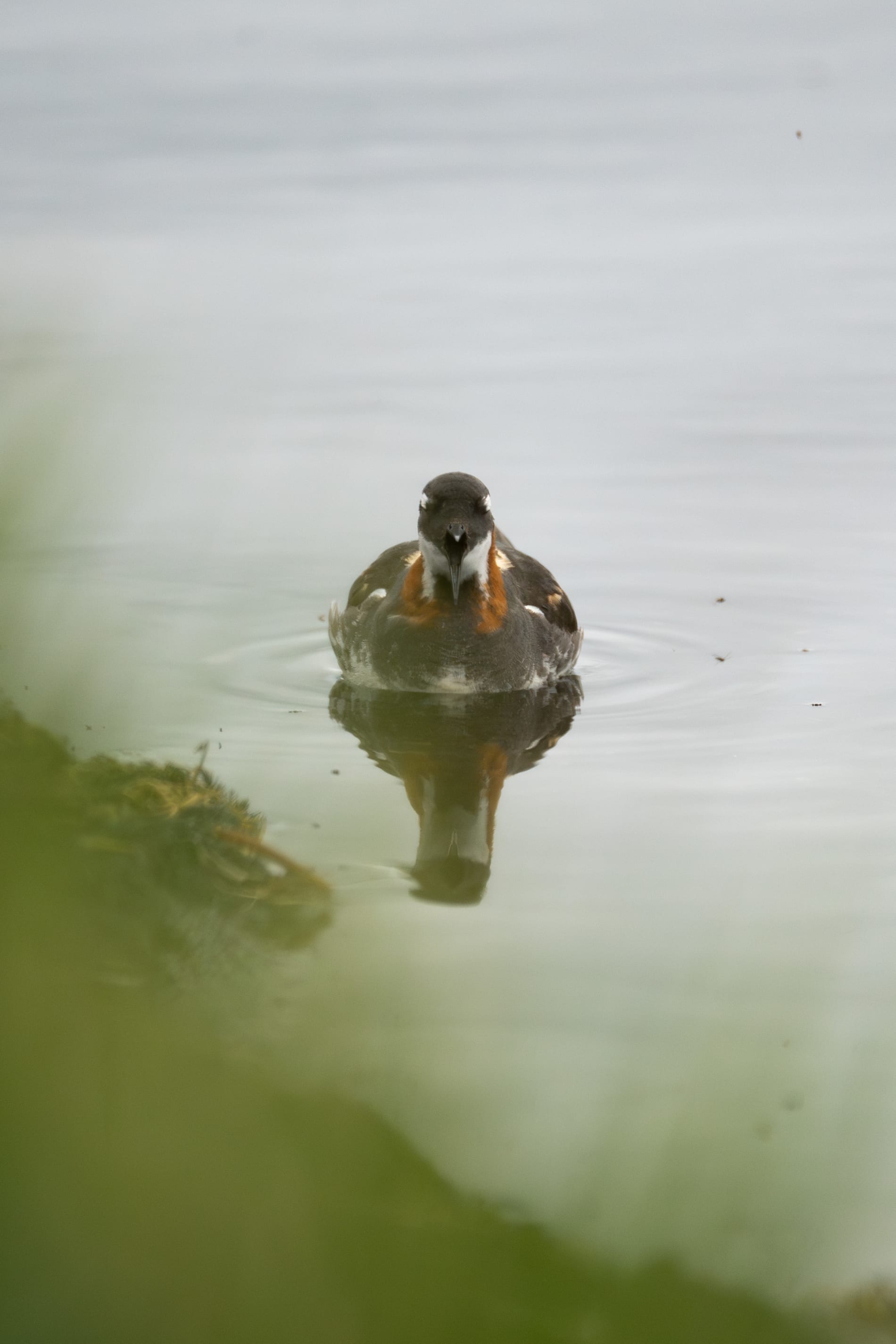
            <img src="https://res.cloudinary.com/dy8r02i02/image/upload/f_auto,w_1900,c_scale/DSC07302-Enhanced-NR_n5l35c" alt="Portrait of a female red-necked phalarope on a lake, staring directly at the camera, having her beak open." />
          
          
            <p>Earlier I issued a small bird quiz on <a href="https://mastodon.art/@fosstography/113945866767010157">Mastodon</a> and my <a href="https://instagram.com/fossheim.photography">Instagram</a> stories: a red-necked phalarope couple, along with a poll to guess which one was the male and which one the female.</p>
<p>The majority of respondents assumed the slightly larger and more brightly colored individual was the male, which makes sense given the fact that male birds are typically those with the more extravagant plumage.</p>
<p>But it was a trick question, it's actually the exact opposite with the red-necked phalaropes!</p>

          
          <h2>The red-necked phalarope couple.</h2>
<img src="https://res.cloudinary.com/dy8r02i02/image/upload/f_auto,w_1900,c_scale/DSC07236-Enhanced-NR_vlahpg" alt="two red-necked phalaropes wandering around between the grass: The one on the left is more darker gray on the back, with a bright orange/red stripe on each side of the neck, white cheeks, a white dot above the eye, and orange stripes on the back. The one on the right is a bit more brown, the orange stripe on the neck is less bright, blends in more with the brown-ish plumage, and continues up until the eye. The feathers have a bit more white specks on them too. Both have a sharp black bill." />
<div class="container">
<p>This picture of two red-necked phalaropes was taken in June 2023 in the north of Iceland by lake Mývatn, where a lot of these small waders can be found.</p>
<p>The individual on the left is the female. The orange band on her neck is brighter and more defined than that one of the male, which is the bird on the right. His feathers are a bit duller, and the feathers on his back are a bit more brown than the female's as well.</p>
<h2>Reversed gender roles.</h2>
<p>We may think of male birds as those that fight over the females, and the females as the ones that incubate the eggs, but several waders tend to do things a bit differently.</p>
<p>For example, purple sandpipers are monogamous and share the egg incubation duties, but as soon the chicks hatch, the <a href="/blog/purple-sandpiper-gender-roles-svalbard">females leave the nesting areas and their partners raise the chicks</a>.</p>
<p>And another example of waders having <em>&quot;non-traditional&quot;</em> gender roles are these red-necked phalaropes.</p>
<div class="container">
<p><a href="/photos/catalog/2024/2024-04-03-kiberg/phalarope-1/"></p>
  <img class="main-image" src="https://res.cloudinary.com/dy8r02i02/image/upload/f_auto,w_1900,c_scale/DSC01795-Enhanced-NR_pwyfjf" alt="Portrait of a female red-necked phalarope on a lake, with grass in the background. The phalarope has a gray body and head, with a white dot above the eye, a white belly, and a white patch on the chin. On each side of the neck, there&#39;s a strip with deep bright orange/red colored feathers." />
<p></a></p>
</div>
<p>
<p><em>Female red-necked phalarope in Kiberg (Vardø), June 2024.</em></p>
</p>
</div>
<div class="container">
<p>The girl red-necked phalaropes are the ones chasing down the boys and fighting other girls over them. As soon as the eggs are laid, the girls leave the guys, leaving the guys to incubate the eggs and rear the young. After leaving their partner with the eggs, the female phalaropes may even find a new guy to restart the process with, laing several clutches of eggs a season, each with a different dad.</p>
<h3>Behavior and plumage.</h3>
<p>Given their breeding behavior, makes sense that their plumage is opposite from the traditional as well.</p>
<p>The male red-necked phalaropes spend more time stationary on the nest, so it's beneficial to have less saturated and browner colors, providing them with better camouflage.</p>
<p>At the same time, the brighter colors may benefit the females when it comes to competing over and seducing males.</p>
</div>
<div>
<div class="collection-photos container full">
<div class="collection-grid" data-stretch="" data-size="" data-type="medium" data-alignment="center" data-shape="normal" data-stretch="">
<div>
<a href="/photos/catalog/2023/iceland/phalarope-1/">
<img class="main-image" src="https://res.cloudinary.com/dy8r02i02/image/upload/f_auto,w_1900,c_scale/DSC07302-Enhanced-NR_n5l35c" alt="Portrait of a female red-necked phalarope on a lake, staring directly at the camera, having her beak open." />
</a>
</div>
<div>
<a href="/photos/catalog/2023/iceland/phalarope-2/">
<img class="main-image" src="https://res.cloudinary.com/dy8r02i02/image/upload/f_auto,w_1900,c_scale/DSC07300-Enhanced-NR_djwyuj" alt="Portrait of a male red-necked phalarope, preening and drying himself on a rock next to a lake, picture taken from inbetween long grass" />
</a>
</div>
</div>
</div>
</div>
        ]]>
      </content>
    </entry>
  
    <entry>
      <title>photo: Red-necked Phalarope</title>
      
        <link href="https://fossheim.photography/photos/catalog/2024/2024-04-03-kiberg/phalarope-1" />
      
      <updated>2024-06-03T00:00:00.000Z</updated>
      
      
        <id>https://fossheim.photography/photos/catalog/2024/2024-04-03-kiberg/phalarope-1"</id>
      
      <content type="html"><![CDATA[
          
            <img src="https://res.cloudinary.com/dy8r02i02/image/upload/f_auto,w_1900,c_scale/DSC01795-Enhanced-NR_pwyfjf" alt="Portrait of a female red-necked phalarope on a lake, with grass in the background. The phalarope has a gray body and head, with a white dot above the eye, a white belly, and a white patch on the chin. On each side of the neck, there&#39;s a strip with deep bright orange/red colored feathers." />
          
          
            <p>Female red-necked phalarope <em>(svømmesnipe)</em>, photographed in Varanger (Finnmark, Norway) at night under the midnight sun in June.</p>
<p>This is a female, which we can tell because of the color of the plumage, which is more saturated and higher in contrast than the male's feathers. The females are more grey and have a more defined red/orange neck, whereas the males are more brown and dull in color.</p>


        ]]>
      </content>
    </entry>
  
    <entry>
      <title>photo: Red-necked Phalarope</title>
      
        <link href="https://fossheim.photography/photos/catalog/2023/iceland/phalarope-2" />
      
      <updated>2023-06-19T00:00:00.000Z</updated>
      
      
        <id>https://fossheim.photography/photos/catalog/2023/iceland/phalarope-2"</id>
      
      <content type="html"><![CDATA[
          
            <img src="https://res.cloudinary.com/dy8r02i02/image/upload/f_auto,w_1900,c_scale/DSC07300-Enhanced-NR_djwyuj" alt="Portrait of a male red-necked phalarope, preening and drying himself on a rock next to a lake, picture taken from inbetween long grass" />
          
          
            <p>Our honeymoon in Iceland in June 2023 marked our first encounter with the red-necked phalarope, a small bird part of the snipe family <em>(Scolopacidae)</em>, characterized by its bright orange stripes on the neck.</p>
<p>During our walk around Lake Mývatn, in the North of Iceland, we found them running around along a big part of the track, often in pairs.</p>
<p>This male red-necked phalarope was preening himself by the side of the lake, after cleaning himself in the water earlier. Male phalaropes are a bit less colorful than the females, and the orange stripes on their necks are less defined.</p>


        ]]>
      </content>
    </entry>
  
    <entry>
      <title>photo: Red-necked Phalarope</title>
      
        <link href="https://fossheim.photography/photos/catalog/2023/iceland/phalarope-1" />
      
      <updated>2023-06-19T00:00:00.000Z</updated>
      
      
        <id>https://fossheim.photography/photos/catalog/2023/iceland/phalarope-1"</id>
      
      <content type="html"><![CDATA[
          
            <img src="https://res.cloudinary.com/dy8r02i02/image/upload/f_auto,w_1900,c_scale/DSC07302-Enhanced-NR_n5l35c" alt="Portrait of a female red-necked phalarope on a lake, staring directly at the camera, having her beak open." />
          
          
            <p>Our honeymoon in Iceland in June 2023 marked our first encounter with the red-necked phalarope, a small bird part of the snipe family <em>(Scolopacidae)</em>, characterized by its bright orange stripes on the neck.</p>
<p>During our walk around Lake Mývatn, in the North of Iceland, we found them running around along a big part of the track, often in pairs.</p>
<p>The one pictured here is a female red-necked phalarope, which is much brighter and more colorful than the male.</p>
<p>This is different from many other bird species, where typically the male is more colorul to be attractive towards potential mates, whereas the females need camouflage while sitting on the nest or caring for the young.</p>
<p>However, the phalarope's gender roles are reversed. The females need to make themselves seem like attractive and healthy mates, then as soon as they've laid their eggs, they disappear and the male takes over as the sole caregiver. This makes <em>duller</em> males more advantageous, since they'll be less noticeable by predators during the nesting period.</p>


        ]]>
      </content>
    </entry>
  
</feed>