<feed xmlns="http://www.w3.org/2005/Atom">
  <title>Blog: Fossheim Photography</title>
	<subtitle>Nature, wildlife, and bird photography by Sarah Fossheim 🌿</subtitle>
	<link href="https://fossheim.photography/blog/"/>
  <link href="https://fossheim.photography/blog/feed.xml" rel="self"/>
  <updated>2025-02-05T00:00:00.000Z</updated>
  <id>https://fossheim.photography/</id>
  <author>
    <name>Sarah L. Fossheim</name>
    <email>hi@fossheim.photography</email>
	</author>

  
    <entry>
      <title>Plumage and gender roles of the red-necked phalaropes</title>
      <link href="https://fossheim.photography/blog/red-necked-phalarope-challenge" />
      <updated>2025-02-05T00:00:00.000Z</updated>
      <id>https://fossheim.photography/blog/red-necked-phalarope-challenge"</id>
      <content type="html"><![CDATA[
          
          
            <p>Earlier I issued a small bird quiz on <a href="https://mastodon.art/@fosstography/113945866767010157">Mastodon</a> and my <a href="https://instagram.com/fossheim.photography">Instagram</a> stories: a red-necked phalarope couple, along with a poll to guess which one was the male and which one the female.</p>
<p>The majority of respondents assumed the slightly larger and more brightly colored individual was the male, which makes sense given the fact that male birds are typically those with the more extravagant plumage.</p>
<p>But it was a trick question, it's actually the exact opposite with the red-necked phalaropes!</p>

          
          <h2>The red-necked phalarope couple.</h2>
<img src="https://res.cloudinary.com/dy8r02i02/image/upload/f_auto,w_1900,c_scale/DSC07236-Enhanced-NR_vlahpg" alt="two red-necked phalaropes wandering around between the grass: The one on the left is more darker gray on the back, with a bright orange/red stripe on each side of the neck, white cheeks, a white dot above the eye, and orange stripes on the back. The one on the right is a bit more brown, the orange stripe on the neck is less bright, blends in more with the brown-ish plumage, and continues up until the eye. The feathers have a bit more white specks on them too. Both have a sharp black bill." />
<div class="container">
<p>This picture of two red-necked phalaropes was taken in June 2023 in the north of Iceland by lake Mývatn, where a lot of these small waders can be found.</p>
<p>The individual on the left is the female. The orange band on her neck is brighter and more defined than that one of the male, which is the bird on the right. His feathers are a bit duller, and the feathers on his back are a bit more brown than the female's as well.</p>
<h2>Reversed gender roles.</h2>
<p>We may think of male birds as those that fight over the females, and the females as the ones that incubate the eggs, but several waders tend to do things a bit differently.</p>
<p>For example, purple sandpipers are monogamous and share the egg incubation duties, but as soon the chicks hatch, the <a href="/blog/purple-sandpiper-gender-roles-svalbard">females leave the nesting areas and their partners raise the chicks</a>.</p>
<p>And another example of waders having <em>&quot;non-traditional&quot;</em> gender roles are these red-necked phalaropes.</p>
<div class="container">
<p><a href="/photos/catalog/2024/2024-04-03-kiberg/phalarope-1/"></p>
  <img class="main-image" src="https://res.cloudinary.com/dy8r02i02/image/upload/f_auto,w_1900,c_scale/DSC01795-Enhanced-NR_pwyfjf" alt="Portrait of a female red-necked phalarope on a lake, with grass in the background. The phalarope has a gray body and head, with a white dot above the eye, a white belly, and a white patch on the chin. On each side of the neck, there&#39;s a strip with deep bright orange/red colored feathers." />
<p></a></p>
</div>
<p>
<p><em>Female red-necked phalarope in Kiberg (Vardø), June 2024.</em></p>
</p>
</div>
<div class="container">
<p>The girl red-necked phalaropes are the ones chasing down the boys and fighting other girls over them. As soon as the eggs are laid, the girls leave the guys, leaving the guys to incubate the eggs and rear the young. After leaving their partner with the eggs, the female phalaropes may even find a new guy to restart the process with, laing several clutches of eggs a season, each with a different dad.</p>
<h3>Behavior and plumage.</h3>
<p>Given their breeding behavior, makes sense that their plumage is opposite from the traditional as well.</p>
<p>The male red-necked phalaropes spend more time stationary on the nest, so it's beneficial to have less saturated and browner colors, providing them with better camouflage.</p>
<p>At the same time, the brighter colors may benefit the females when it comes to competing over and seducing males.</p>
</div>
<div>
<div class="collection-photos container full">
<div class="collection-grid" data-stretch="" data-size="" data-type="medium" data-alignment="center" data-shape="normal" data-stretch="">
<div>
<a href="/photos/catalog/2023/iceland/phalarope-1/">
<img class="main-image" src="https://res.cloudinary.com/dy8r02i02/image/upload/f_auto,w_1900,c_scale/DSC07302-Enhanced-NR_n5l35c" alt="Portrait of a female red-necked phalarope on a lake, staring directly at the camera, having her beak open." />
</a>
</div>
<div>
<a href="/photos/catalog/2023/iceland/phalarope-2/">
<img class="main-image" src="https://res.cloudinary.com/dy8r02i02/image/upload/f_auto,w_1900,c_scale/DSC07300-Enhanced-NR_djwyuj" alt="Portrait of a male red-necked phalarope, preening and drying himself on a rock next to a lake, picture taken from inbetween long grass" />
</a>
</div>
</div>
</div>
</div>
        ]]>
      </content>
    </entry>
  
    <entry>
      <title>Gloria, our neighboring herring gull, received a ring.</title>
      <link href="https://fossheim.photography/blog/2025-01-22-gloria-ring" />
      <updated>2025-01-22T00:00:00.000Z</updated>
      <id>https://fossheim.photography/blog/2025-01-22-gloria-ring"</id>
      <content type="html"><![CDATA[
          
          
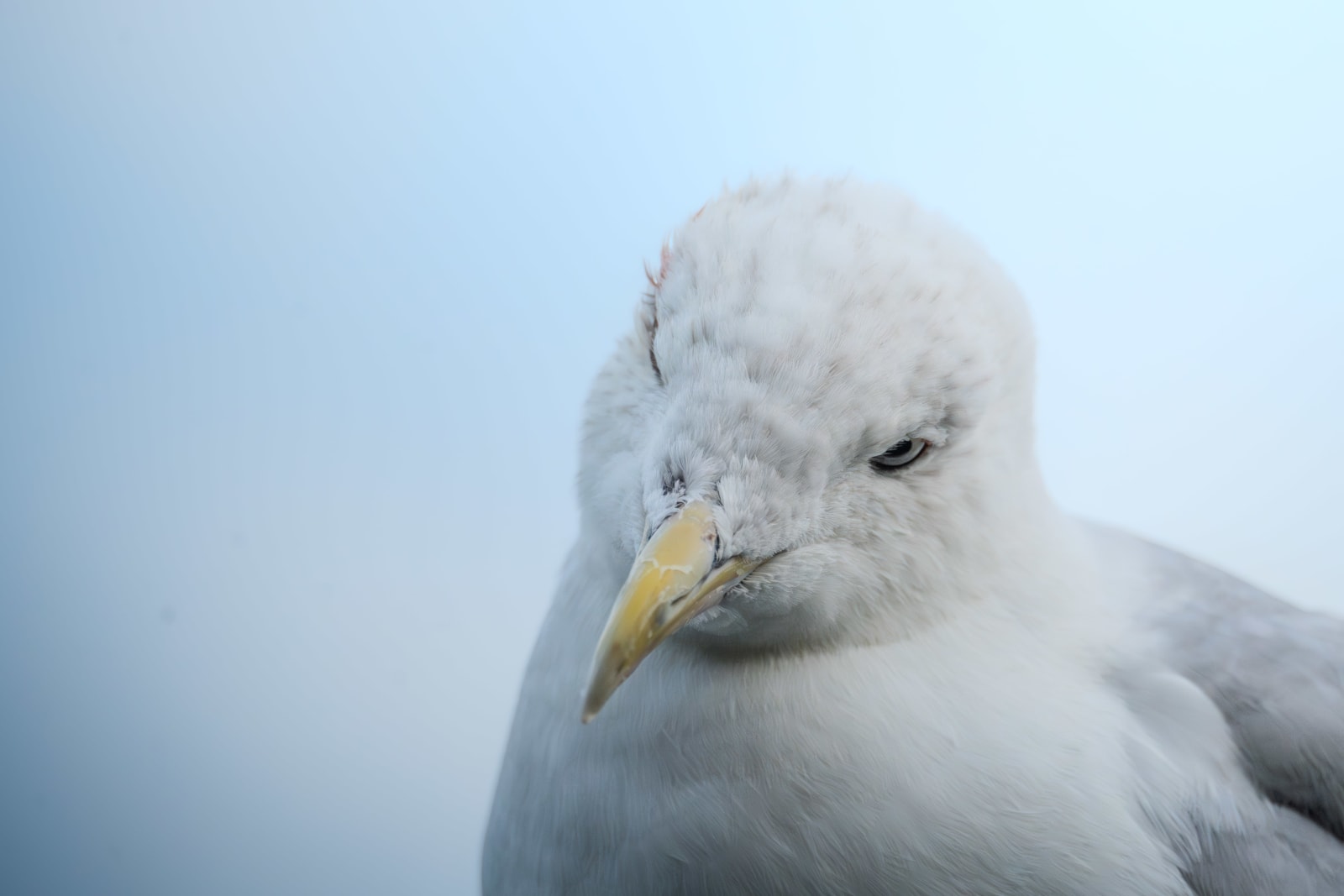
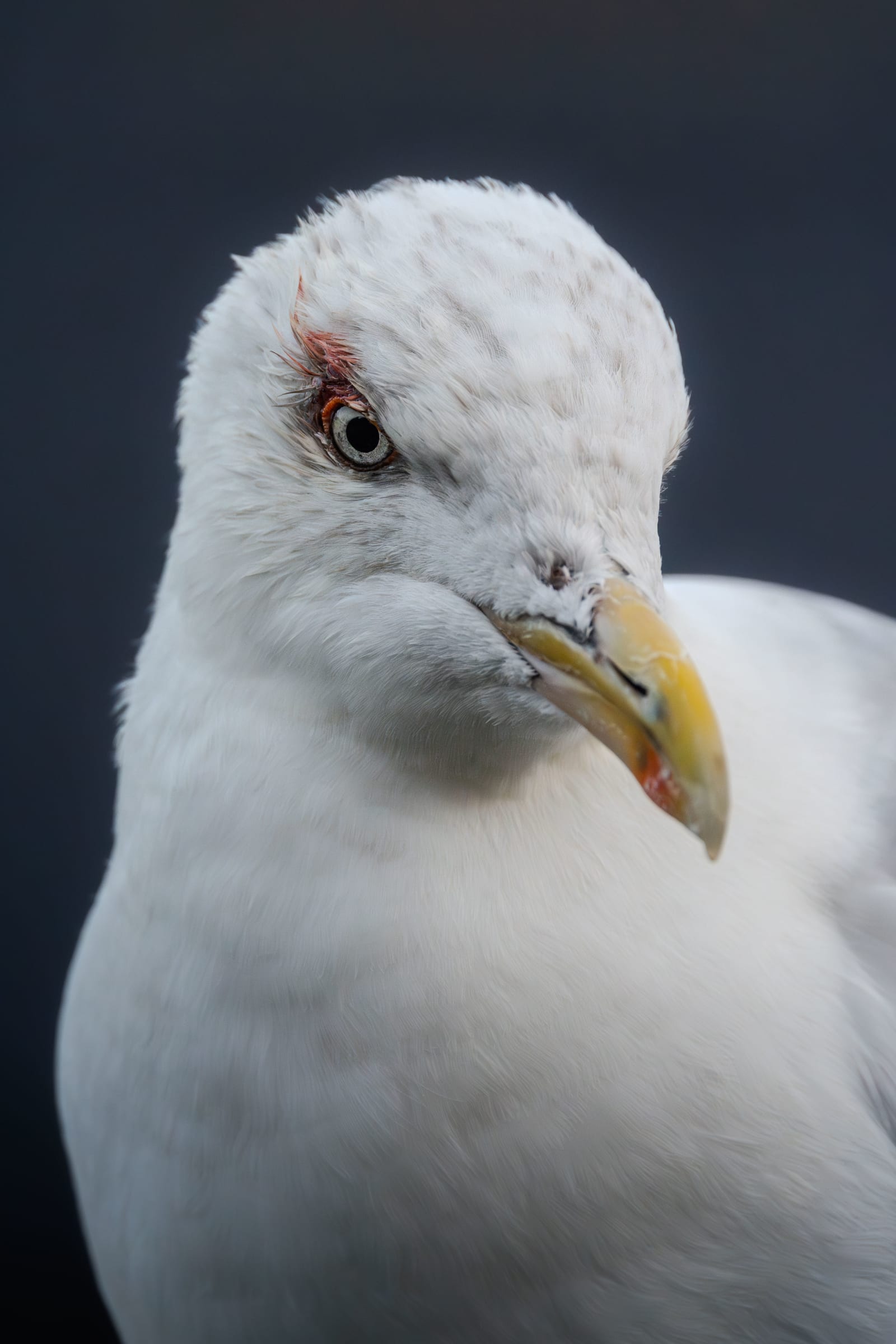
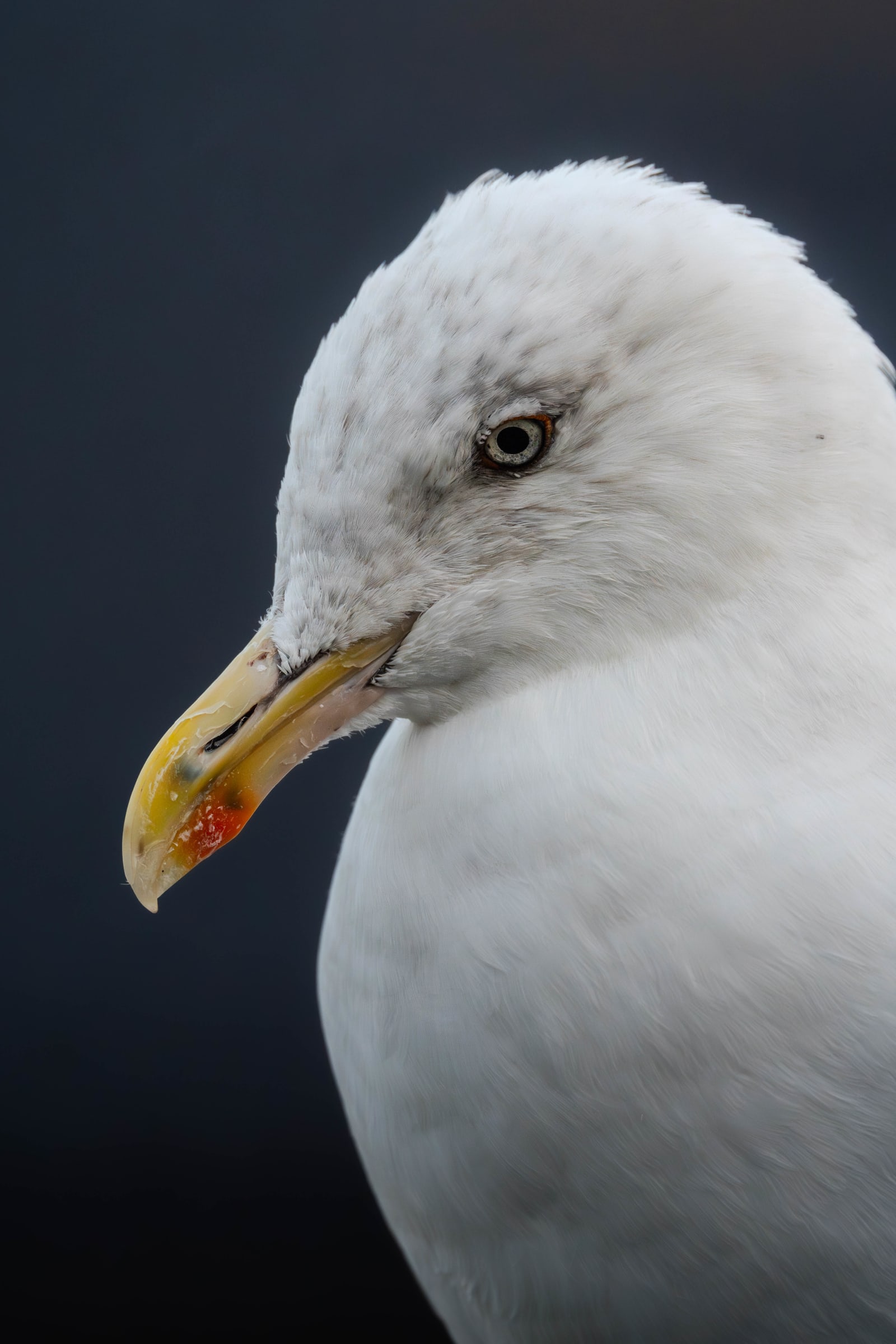
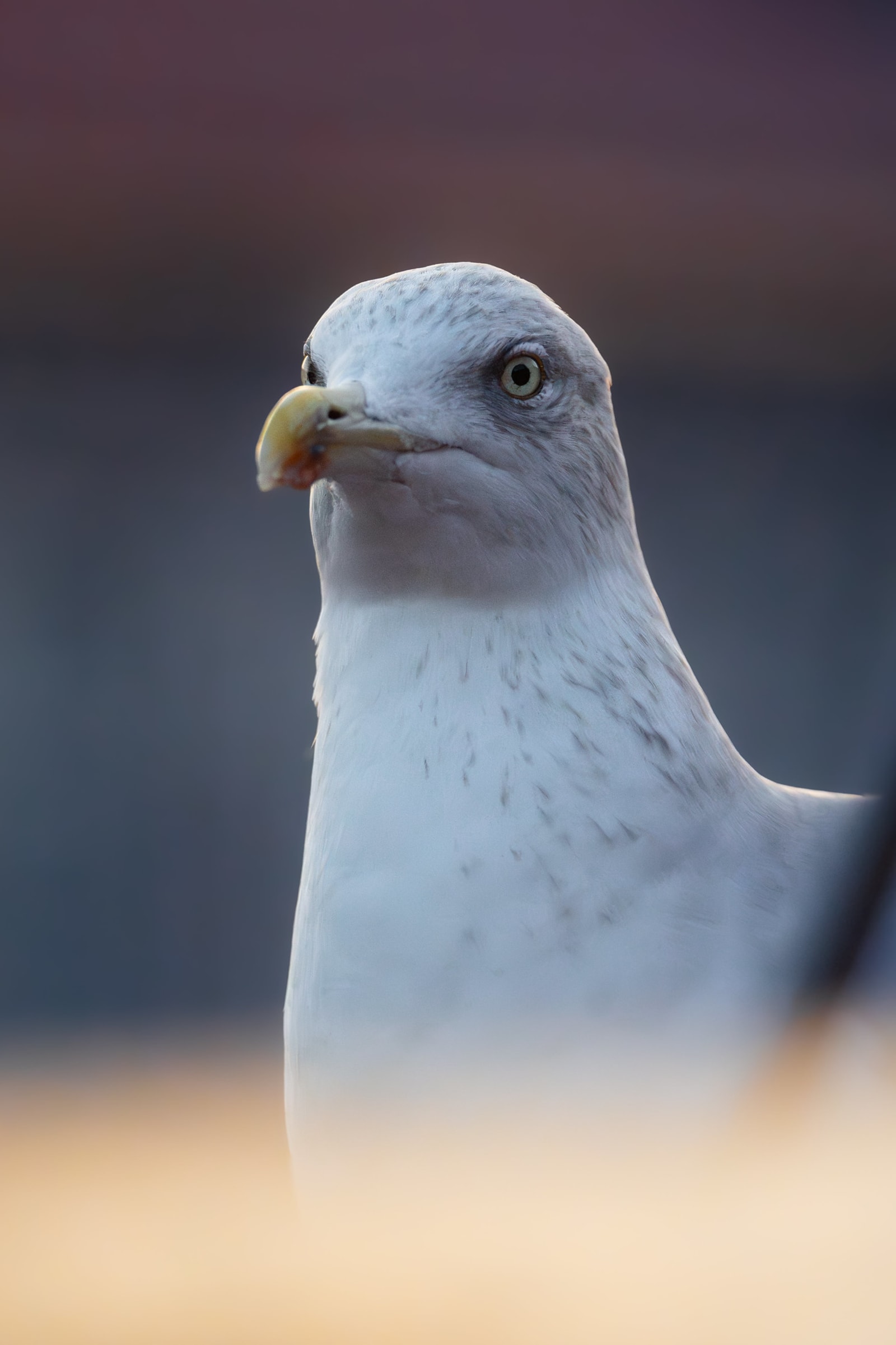
            <p>Almost every day, the same gulls return to the same rooftops of our neighborhood. One of them is a fierce one we call Gloria, who recently popped up on the balcony wearing a ring, giving us a bit more information about their background.</p>

          
          <div class="container size-s">
<p>I previously (exactly five months ago), <a href="/blog/2024-08-22-meet-gloria/">wrote about Gloria</a>, a herring gull who frequently visits our rooftop.</p>
<p>We were quite conident back then that she was a girl-gull, partially because she was often hanging out with two ringed terrifying boys <em>(JLN44 aka Julien, and JMT80 aka Jean-Marie)</em>, and we assumed one of them must have been her partner.</p>
<p>During breeding season she disappeared for a while, and eventually returned as a proud parent together with a youngster who kept, without any luck, begging for food, and several evenings Gloria stayed behind on the balcony for a few more hours after the rest of the flock had left, napping and recharging from the exhausting duties of being a new parent.</p>
<p>We kept following the adventures of our fierce <s>girl</s>gull from our balcony, recognizing her by the pattern of her iris. And big was our surprise when earlier this month she came to visit with a freshly put color ring, providing us with a bit more background information on her.</p>
<p>And as it turns out, she's a he! Our fearless Gloria is actually Glorius, a big boy with a beak and head length of 126.5mm and wing length of 454mm, weighing a bit over a kilo.</p>
<p>Since receiving the ring, he's only been observed at the location of his ringing and our rooftop, but I'm excited to find out where else he will pop up. Maybe next summer he'll be observed on a nest?</p>
</div>
<div class="container size-s accent-headlines">
  <h2 class="text-center">Related pictures...</h2>
</div>
<div class="collection-photos container size-l">
<div class="collection-grid" data-stretch="" data-size="" data-type="medium" data-alignment="center" data-shape="normal" data-stretch="stretch">
<div>
<a href="/photos/catalog/2024/2024-08-08-balcony/gloria-blood-1/">
<img class="main-image" src="https://res.cloudinary.com/dy8r02i02/image/upload/f_auto,w_1900,c_scale/gloria-blood-1" alt="Portrait photo from the chest upwards of an adult European Herring Gull just moulting into winter plumage, with light  brown stripes on the head. She&#39;s looking towards the camera, and around her right eye her feathers are standing upwards and have blood on them." />
</a>
</div>
<div>
<a href="/photos/catalog/2025/2025-01-balcony/gloria/">
<img class="main-image" src="https://res.cloudinary.com/dy8r02i02/image/upload/f_auto,w_1900,c_scale/DSC07617-Enhanced-NR_vfbnpo" alt="High-contrast picture of an adult herring gull in winter plummage. He has bright white feathers with brown/gray stripes on the head and neck, and an orange beak." />
</a>
</div>
</div>
</div>

        ]]>
      </content>
    </entry>
  
    <entry>
      <title>About the beautiful bridled common murres.</title>
      <link href="https://fossheim.photography/blog/bridled-common-murre-fun-facts" />
      <updated>2024-09-03T00:00:00.000Z</updated>
      <id>https://fossheim.photography/blog/bridled-common-murre-fun-facts"</id>
      <content type="html"><![CDATA[
          
          
            <p>It’s no secret that murres are my favorite birds. I fell in love with the thick-billed murres (Uria lomvia) while in Svalbard in 2017, and they’re the birds that sort of got me into birding. Since then I’ve gotten to know the common murres (Uria aalge) a lot better as well, which are more common on mainland Norway.</p>
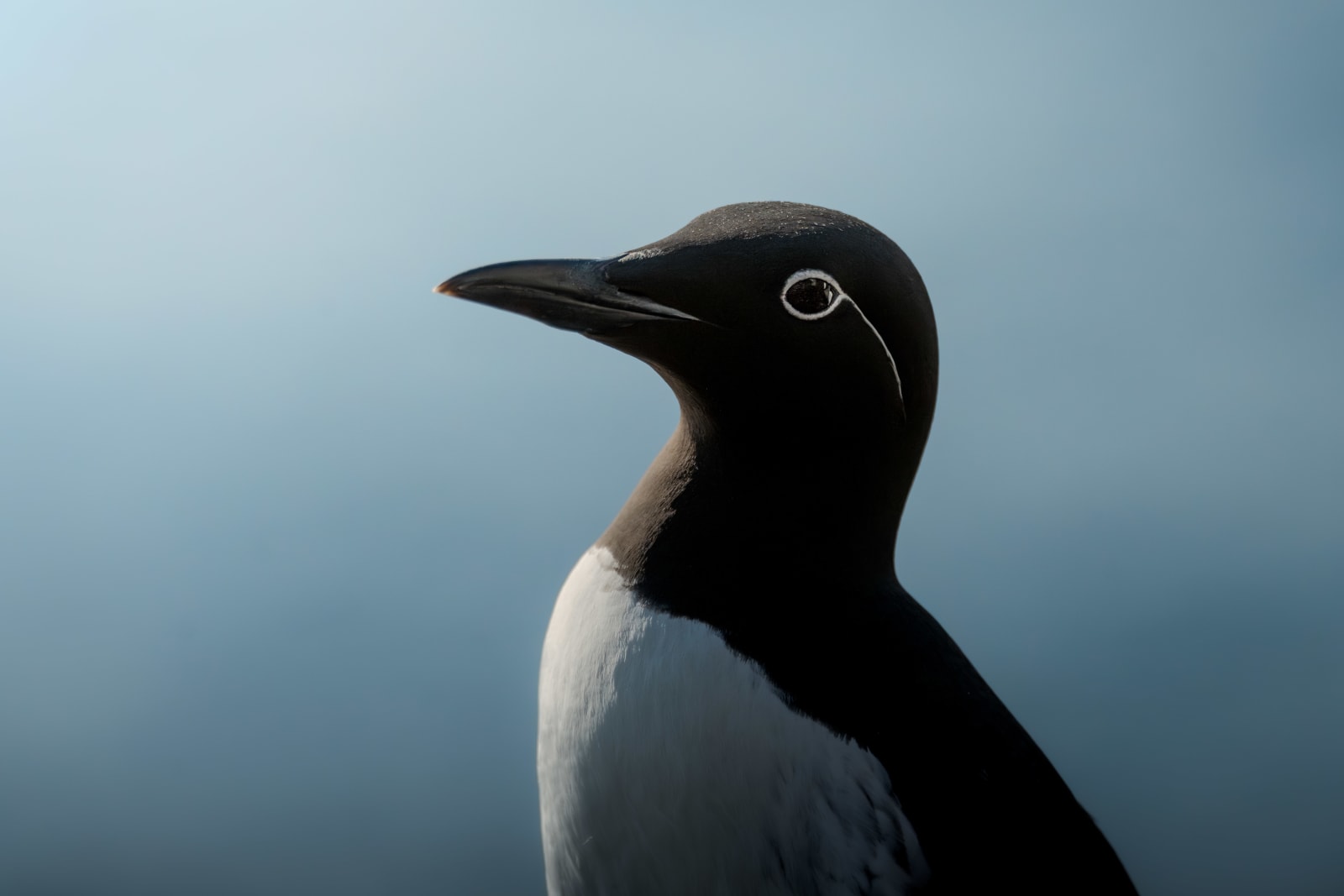
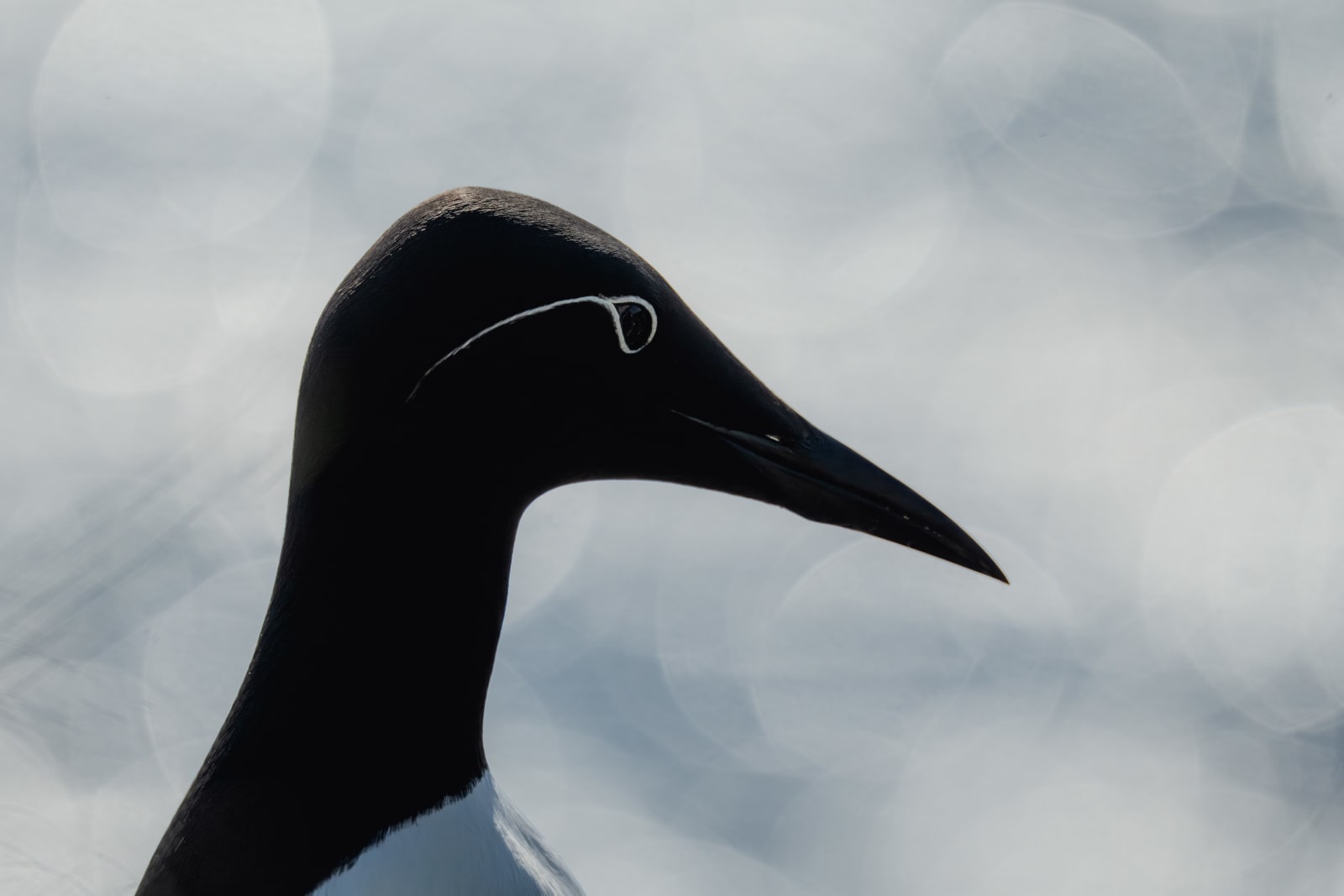
<p>This year I visited them several times at Hornøya, where around a third of the common murres are of the bridled variation (in Norwegian sometimes called <em>ringvi</em> instead of <em>lomvi</em>), which have a white ring and band resembling glasses around the eyes.</p>

          
          <div class="size-m">
  <div class="container">
<p><a href="/photos/catalog/2024-06-19-hornoya/ringvi-1/"></p>
  <img class="main-image" src="https://res.cloudinary.com/dy8r02i02/image/upload/f_auto,w_1900,c_scale/ringvi-hornøya" alt="Portrait of a bridled common murre standing in front of a teal/blue blurry background (out of focus ocean), photographed from the chest up. The belly is white, the back and head are very dark brown (but look black), medium-sized sharp gray beak. Around its eye is a white circle and line, resembling glsses. The bird eye is in focus, along with tiny water droplets on top of the head. Light cimes from the left behind of the murre." />
<p></a></p>
</div>
</div>
<div class="size-s container">
<h2>1) Bridled common murres are not a different species or subspecies</h2>
<p>Bridled common murres are the same species as the “regular” (non-bridled) common murres, the ring is is just a variation in looks.</p>
<h2>2) They’re only found found along the Atlantic coast</h2>
<p>The bridled variation is only found along the Atlantic coast, so Europe and East-coast America. Common murres also breed in the Pacific Ocean (from the gulf of Alaska until California), but the bridled variation is generally not found there. In 2008 researchers observed one bridled common murre in central California.</p>
<p>It’s not clear however if this variation naturally (but just very very rarely) occurs in common murres breeding in the Pacific area as well, or if the observed individuals were just lost Atlantic-ocean murres.</p>
<p>Read more about this:</p>
<ul>
<li><a href="https://archive.westernfieldornithologists.org/archive/V42/WB-V42-1-Schmidt.pdf">First record of the bridled morph of the common murre in the Pacific</a></li>
</ul>
</div>
<div class="size-m">
  <div class="container">
<p><a href="/photos/catalog/2024-06-19-hornoya/lomvi-bokeh/"></p>
  <img class="main-image" src="https://res.cloudinary.com/dy8r02i02/image/upload/f_auto,w_1900,c_scale/lomvi-bokeh_jbjcbl" alt="Common murre silhouette (chest upwards), with a blue sea full of blurry bokeh in the background." />
<p></a></p>
</div>
</div>
<div class="size-s container">
<h2>3) They’re more common in the north</h2>
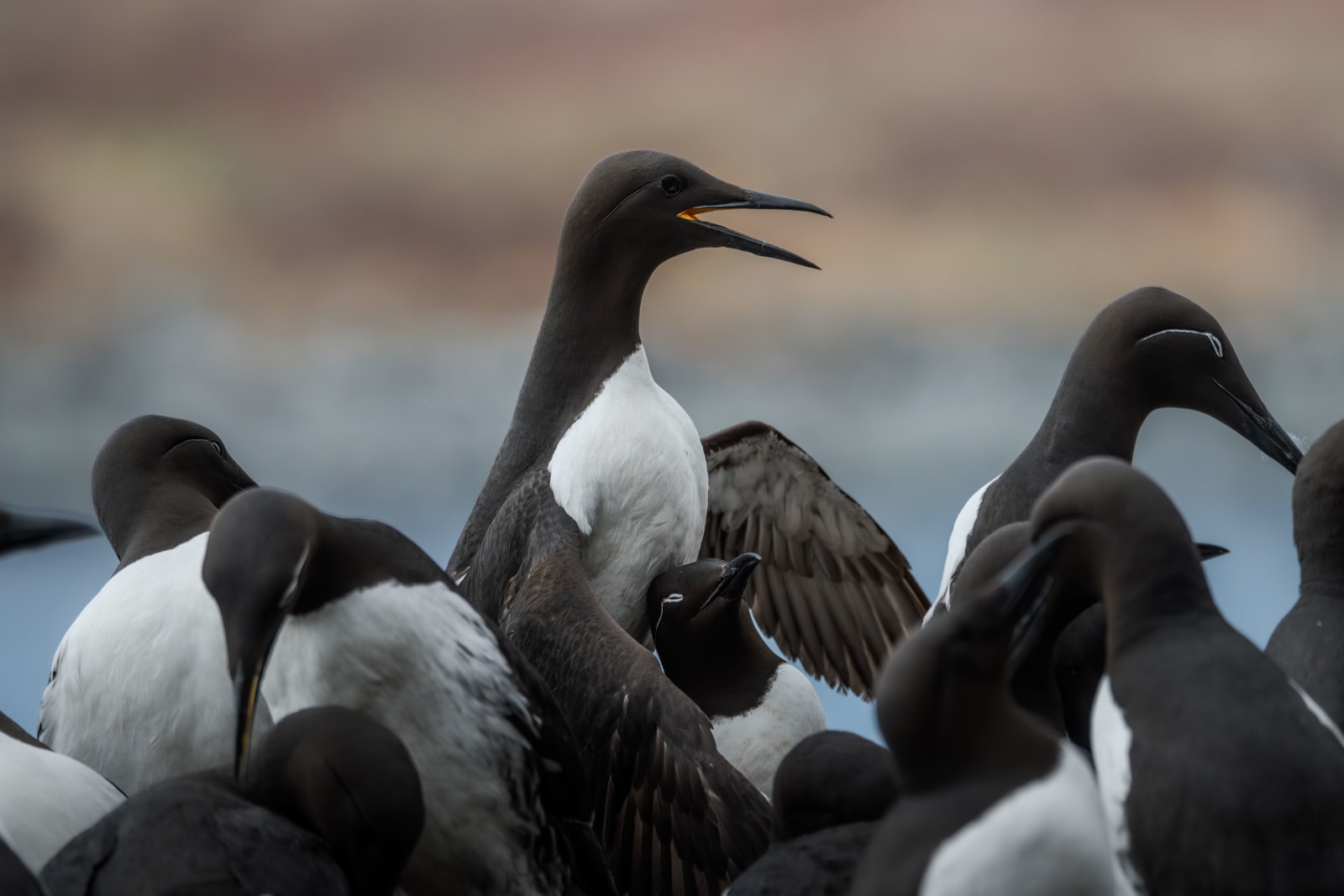
<p>Bridled common murres are more common in northern regions than they are the south. Some colonies in Portugal are exclusively non-bridled, and by Bjørnøya (Svalbard) half the common murre population has glasses. At Hornøya around one third are bridled.</p>
<p>Read more about this:</p>
<ul>
<li><a href="https://www.researchgate.net/publication/229929553_Distribution_of_the_bridled_form_of_the_Common_Guillemot_Uria_aalge_in_the_North_Atlantic">Distribution of the bridled form of the Common guillemot Uria aalge in the North Atlantic</a></li>
<li><a href="https://www.researchgate.net/publication/229990607_Quantitative_Studies_in_the_Geographical_Variation_of_Birds-_The_Common_Guillemot_Uria_aalge_Pont">Quantitative Studies in the Geographical Variation of Birds – The Common Guillemot (Uria aalge)</a></li>
</ul>
<h2>4) They thrive better in colder temperatures</h2>
<p>Bridled common murres seem to be better adapted for cold temperatures. Research showed that mortality amongst bridled common murres was highest after winters with higher temperatures of sea water. This could also explain why they’re more common in northern regions.</p>
<p>Read more about this:</p>
<ul>
<li><a href="https://esajournals.onlinelibrary.wiley.com/doi/10.1890/ES12-00031R">Climate fluctuations and differential survival of bridled and non-bridled Common Guillemots Uria aalge</a></li>
</ul>
</div>
<div class="size-l">
<div class="collection-photos container size-l">
<div class="collection-grid" data-stretch="" data-size="" data-type="large" data-alignment="center" data-shape="normal" data-stretch="">
<div>
<a href="/photos/catalog/2024-04-09-varanger/lomvi-couple/">
<img class="main-image" src="https://res.cloudinary.com/dy8r02i02/image/upload/f_auto,w_1900,c_scale/lomvi-couple_sdm79m" alt="Telezoom portrait of two common murres cuddling and preening eachother, with murres blurred out in the foreground and background" />
</a>
</div>
<div>
<a href="/photos/catalog/2024-06-03-hornoya/lomvi-group-1/">
<img class="main-image" src="https://res.cloudinary.com/dy8r02i02/image/upload/f_auto,w_1900,c_scale/DSC00953-Enhanced-NR-2-edited_doo4ii" alt="Group of 10-15 murres tightly standing together on the side of a cliff, with the ocean in the background. The two murres in the middle are mounting eachother." />
</a>
</div>
</div>
</div>
</div>
<div class="size-s container">
<h2>5) The combination of parents influences the size of the chicks</h2>
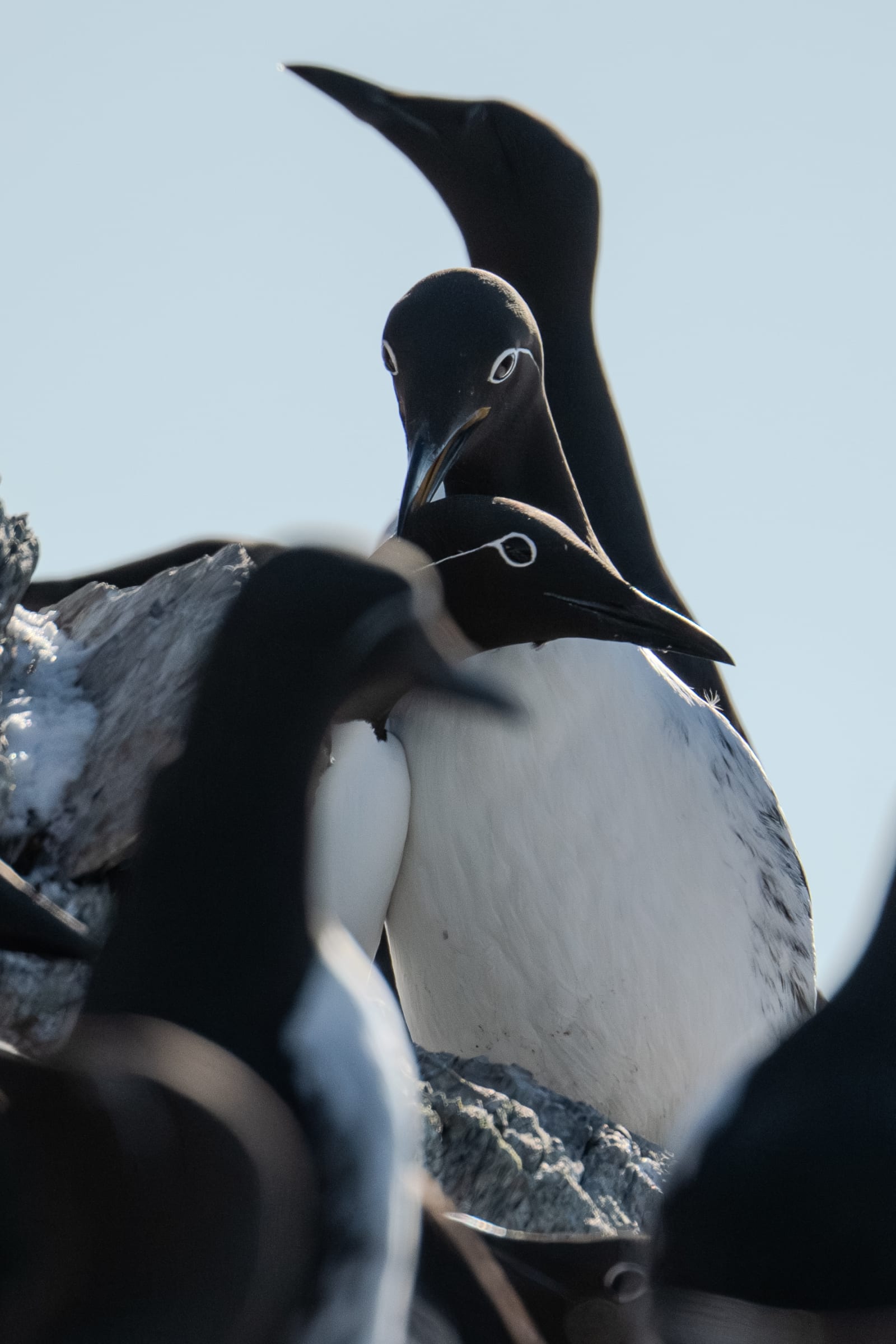
<p>Whether the parents are both bridled, both non-bridled, or mixed seems to play a role in the size of the chicks. Mixed parents, one bridled and one non-bridled, produced larger chicks compared to “pure” bridled and “pure” non-bridled pairs. Bridled common murres were generally the shortest.</p>
<p>Read more about this:</p>
<ul>
<li><a href="https://link.springer.com/article/10.1007/s00265-014-1794-8">Differential breeding investment in bridled and non-bridled common guillemots (Uria aalge): morph of the partner matters</a></li>
</ul>
<p>More murre pictures can be found in my <a href="https://fossheim.photography/species/uriaaalge/">Common Murre / Uria aalge</a> species collection, and <a href="https://shop.fossheim.photography/collections/auks/print">prints can be found in my shop</a>.</p>
</div>

        ]]>
      </content>
    </entry>
  
    <entry>
      <title>The parental roles of purple sandpipers.</title>
      <link href="https://fossheim.photography/blog/purple-sandpiper-gender-roles-svalbard" />
      <updated>2024-08-29T00:00:00.000Z</updated>
      <id>https://fossheim.photography/blog/purple-sandpiper-gender-roles-svalbard"</id>
      <content type="html"><![CDATA[
          
          
            <p>Earlier in August I set myself a new reading goal: read one scientific paper at the end of each work day. It can be related to any subject, but to no one’s surprise, I’ve mainly been picking up bird-related reads.</p>
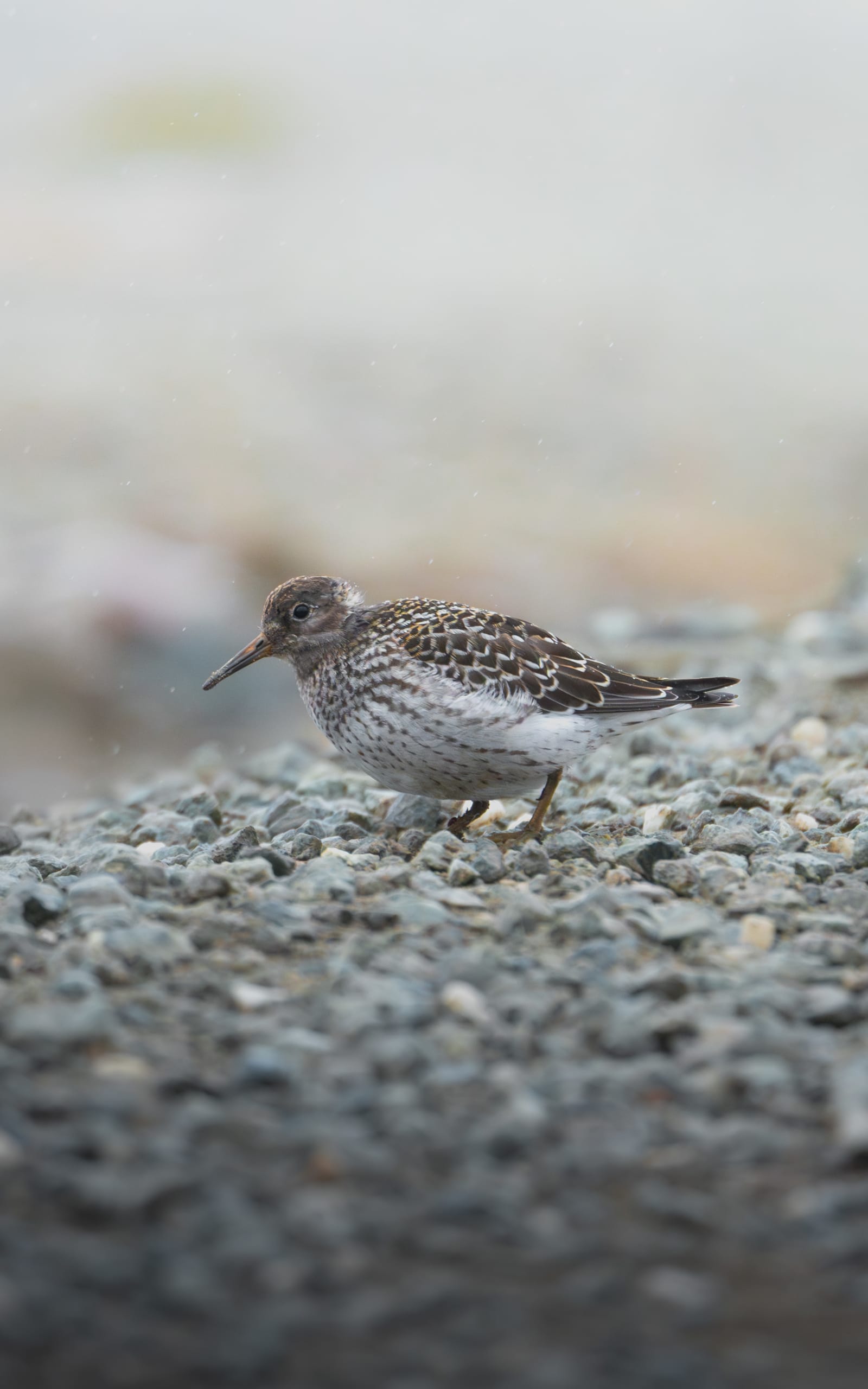
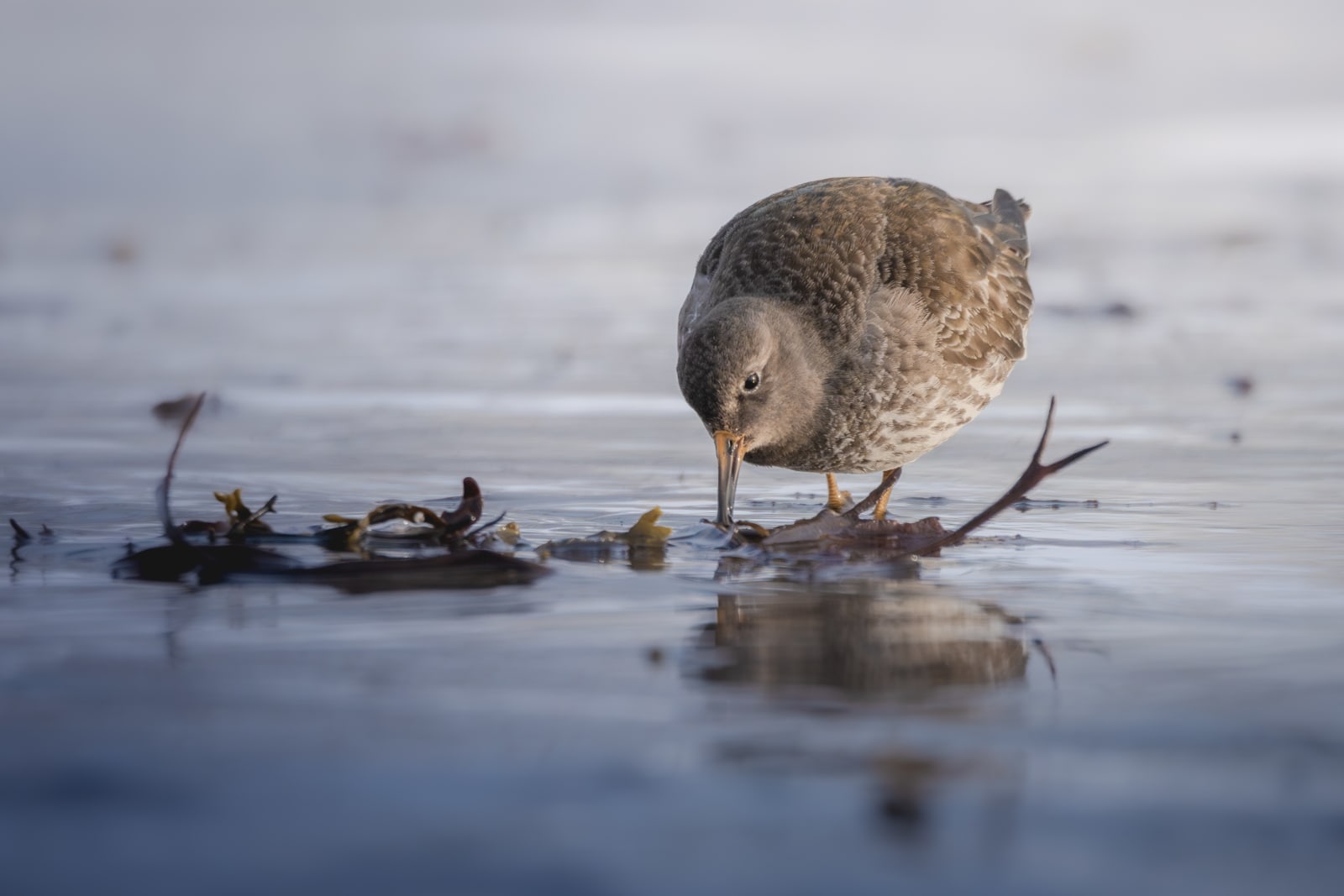
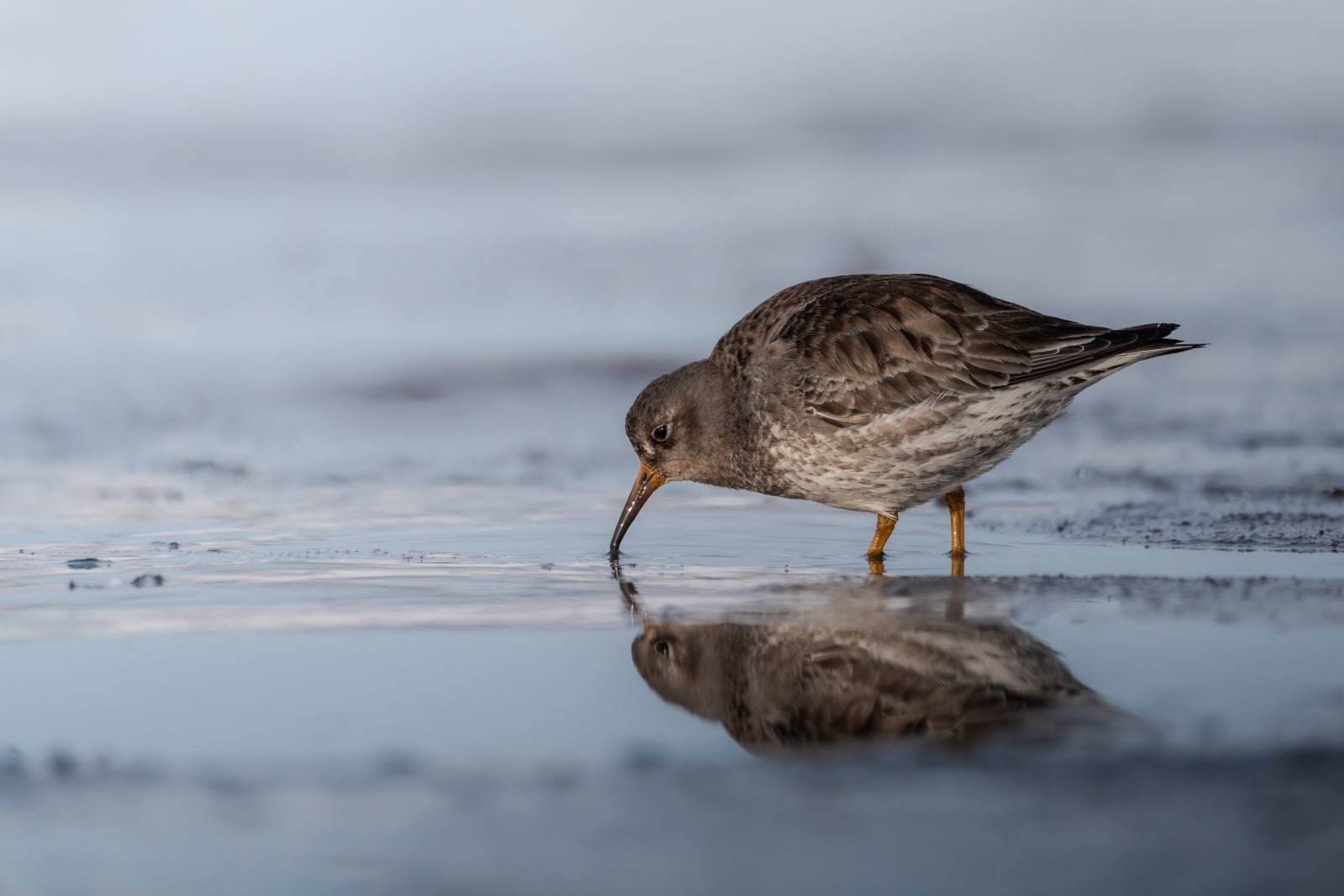
<p>So far it’s been genuinely fun to learn something new every day, and on the menu this week were two articles about a bird I’ve photographed several times but know relatively little about: the purple sandpiper.</p>

          
          <div class="size-l">
<div class="collection-photos container size-l">
<div class="collection-grid" data-stretch="" data-size="" data-type="large" data-alignment="center" data-shape="normal" data-stretch="">
<div>
<a href="/photos/catalog/2023/svalbard/purple-sandpiper-1/">
<img class="main-image" src="https://res.cloudinary.com/dy8r02i02/image/upload/f_auto,w_1900,c_scale/sandpiper-svalbard-1" alt="Purple sandpiper walking on a pebble underground, in rainy but bright weather. The pruple sandpiper is a small wading bird, with long orange legs and a long orange beak. It&#39;s belly is mainly white, the back is beige/brown/blak/white speckles." />
</a>
</div>
<div>
<a href="/photos/catalog/2024/2024-04-09-varanger/purple-sandpiper-2/">
<img class="main-image" src="https://res.cloudinary.com/dy8r02i02/image/upload/f_auto,w_1900,c_scale/nesseby-sandpiper-2" alt="Purple sandpiper foraging in the water. The water is dark blue, and from the top right corner there&#39;s orange light coming into frame. The sandpiper is walking from the top right to the bottom left of the image, and standing on a twig." />
</a>
</div>
</div>
</div>
</div>
<div class="size-s">
<p>Purple sandpipers (calidris maritima) are a small wading shorebird. They overwinter along all of Norway’s shoreline (and other places around the Atlantic coast), are a year-round resident in Northern Norway, and breed as high north as Svalbard.</p>
<p>And, as I learned in the research I read this week, their sex roles during breeding season are quite unique.</p>
<h2>Gender roles of the purple sandpiper</h2>
<p>The egg incubation duties are shared more or less equally, but around hatching time, the female leaves the area until the next breeding season, and the male is the one taking care of the young.</p>
<p>When that happens with shorebirds, it’s typically because the female has multiple clutches with multiple partners. However, purple sandpipers are monogamous, the female leaves the area completely without breeding again, and, they might actually be chased away by the guys, rather than abandoning the nest.</p>
<h2>The papers</h2>
<ul>
<li><a href="https://onlinelibrary.wiley.com/doi/10.1111/j.1474-919X.1997.tb04516.x">Sex roles in the monogamous Purple Sandpiper Calidris maritima in Svalbard</a> by Elin P. Pierce</li>
<li><a href="https://academic.oup.com/beheco/article/21/2/275/320035">Why don’t female purple sandpipers perform brood are?</a> by Elin P. Pierce, Lewis W. Oring, Eivin Røskaft, Jan T. Lifjeld</li>
</ul>
<h2>At first, the female spends most time on the egg.</h2>
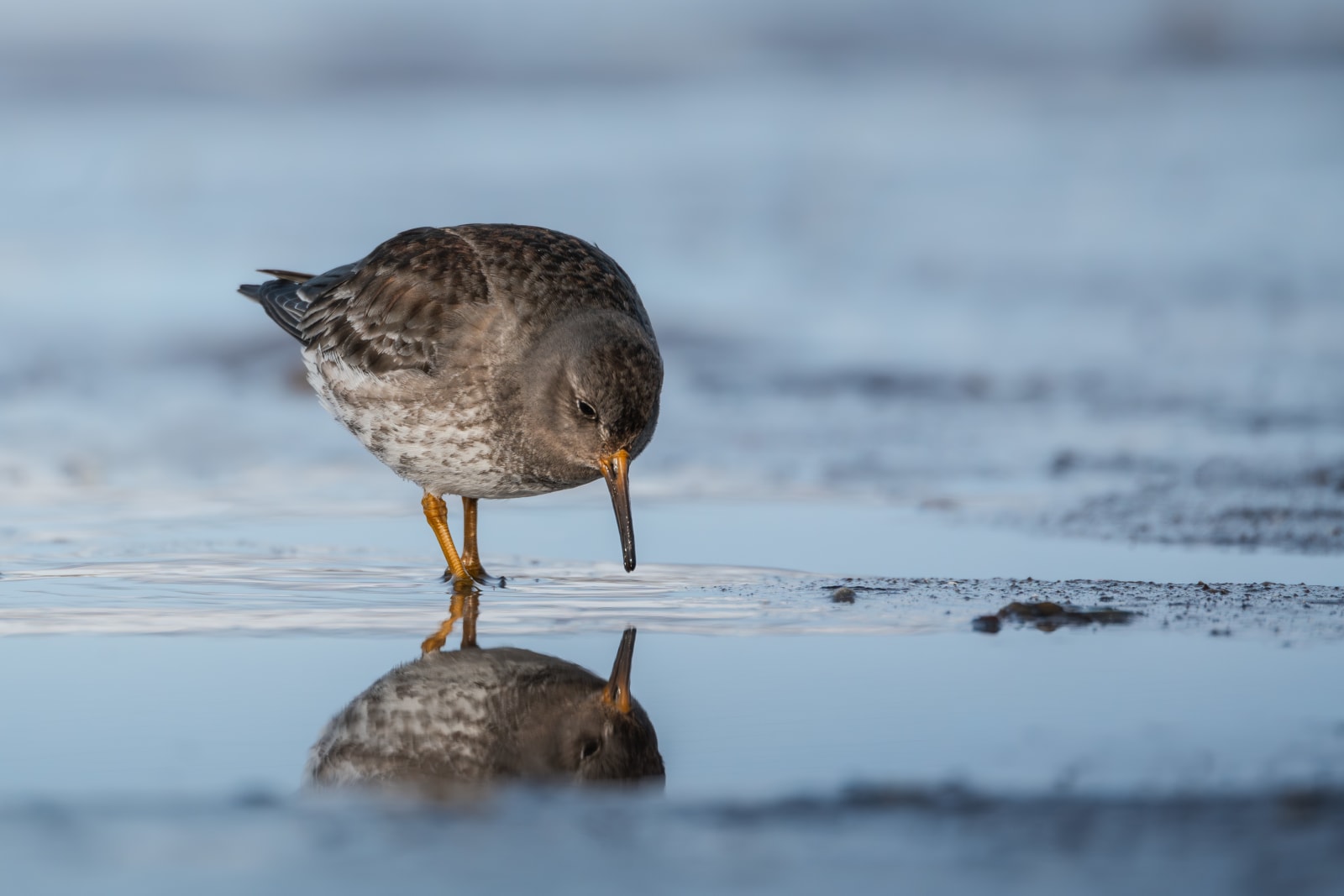
<p>During the first part of the incubation period (the period when birds sit on their eggs), the female purple sandpipers spend most of the time on the nest.</p>
<p>Purple sandpipers breed asynchronous, meaning not all of them start breeding at the same time. While one couple is sitting on eggs already, neighbors may still be arriving. Fights for territory are still common at this point, so it can be useful for the males to spend more time defending the territory in the start, before picking up half the load when things have calmed down.</p>
<p>The male’s reserves may be lower at the start of the incubation period too, because they’ve just used a lot of energy defending or establishing their territory at the start of the mating season. So it can be beneficial for the males to spend more time foraging so they can rebuild their strength before spending more time sitting on the eggs.</p>
</div>
<div class="size-m">
  <div class="container">
<p><a href="/photos/catalog/2024/2024-04-09-varanger/purple-sandpiper-4/"></p>
  <img class="main-image" src="https://res.cloudinary.com/dy8r02i02/image/upload/f_auto,w_1900,c_scale/nesseby-sandpiper-4" alt="Purple sandpiper foraging in very reflective light blue water that has small pieces of ice drifting into it, on a sunny day. The sandpiper is about to take something out of the water, looking at its own reflection." />
<p></a></p>
</div>
</div>
<div class="size-s container">
<h2>Overall, they incubate the eggs equally.</h2>
<p>Even though there’s a short period where the females do most of the incubation, overall the load is shared more or less equally.</p>
<p>Both parents spending equal amount of time on the nest is quite common, and even a necessity, amongst shorebirds like the purple sandpiper.</p>
<h3>Two parents are needed to harch the eggs.</h3>
<p>The rough climate and limited food availability means the sandpiper has to spend a good amount of time away from the nest to forage enough food, which is hard to combine with keeping the eggs warm and safe if you’re a single parent. Researchers observed that if one parent disappeared, the other one would eventually abandon nest and leave the area without trying to mate again.</p>
<h2>The female leaves the area around hatching time.</h2>
<p>Both parents incubate the eggs equally, right until they hatch, after which the female purple sandpipers leave the area and the dads become the sole caregivers to their offspring.</p>
<h3>There’s no advantage to being two parents after hatching.</h3>
<p>One parent can just as effectively warn chicks of danger or guide them to foraging areas as two parents, and camouflage and distraction displays are typically enough to protect the chicks from predators like skuas.</p>
<p>Additionally, considering their habitat (open tundra landscapes with low vegetation), they’re more likely to be detected by predators the larger their group is. So if two parents aren’t (significantly) better than one at raising the young, it doesn’t make sense for one to stick around and increase the risk of predation.</p>
</div>
<div class="size-s container">
  <div class="container">
<p><a href="/photos/catalog/2024/2024-04-09-varanger/purple-sandpiper-3/"></p>
  <img class="main-image" src="https://res.cloudinary.com/dy8r02i02/image/upload/f_auto,w_1900,c_scale/nesseby-sandpiper-3" alt="Group of purple sandpipers foraging in the water. Two of them in the middle are in focus. In front and behind them are out of focus sandpipers." />
<p></a></p>
</div>
</div>
<div class="size-s">
<h3>Both male and female are equally good parents.</h3>
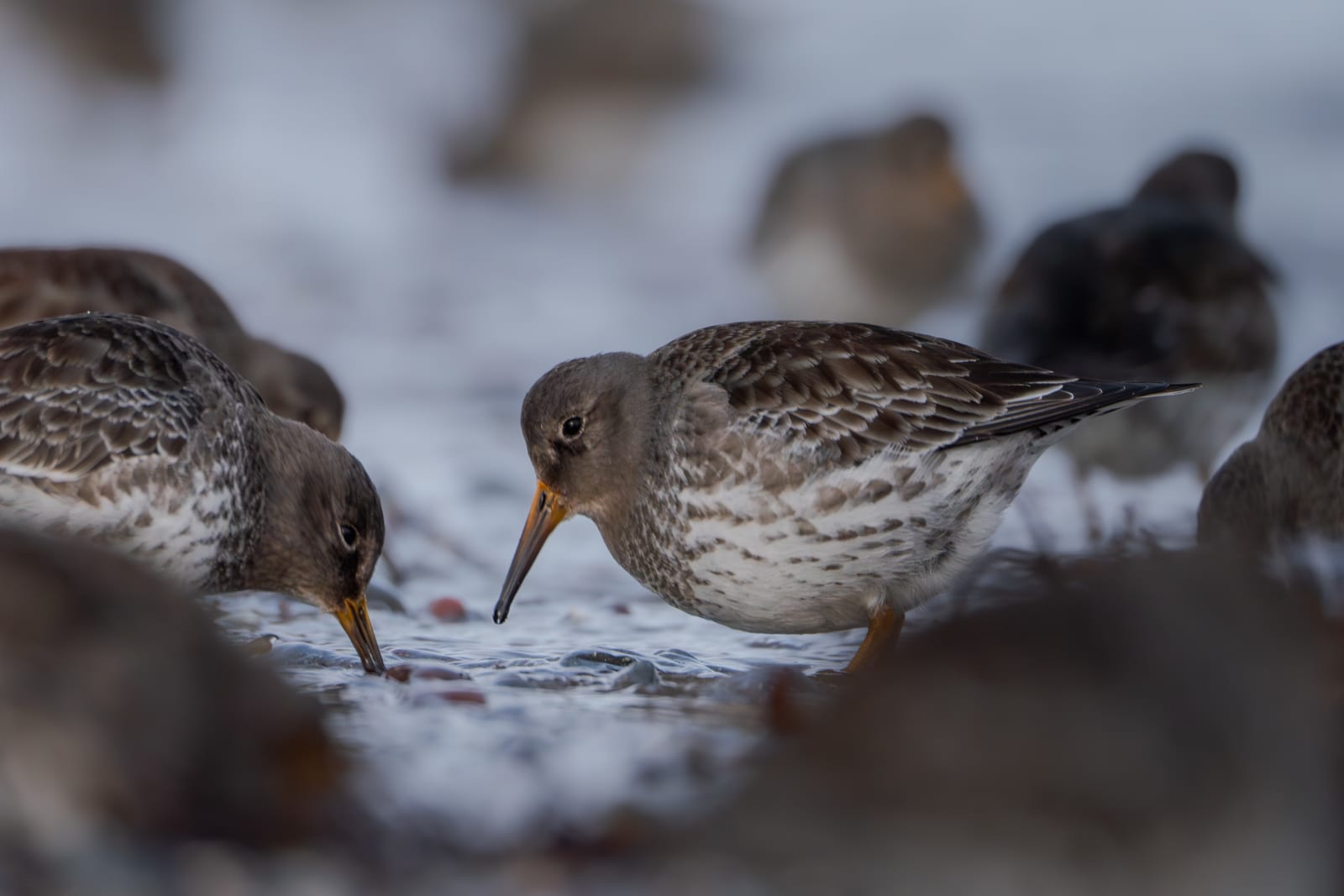
<p>Researchers wondered if the male was the one looking after the chicks because they were better at protecting them from predators, or because the female sandpipers were weakened after using a lot of energy on the eggs.</p>
<p>So one breeding season, they removed the male from a set of nests right around hatching time, the females from another set of nests, and compared them to “untouched” couples. And what they found was quite interesting: male and female purple sandpipers were equally good parents.</p>
<p>They attended to their chicks for the same amount of time as males, showed similar responses to predators, and were just as successful at raising at least one chick to fledging. The chicks raised by female sandpipers gained weight at similar rates than those raised by the males, and the weight loss amongst the adults was similar too.</p>
<h3>Potential advantages for the males to stick around.</h3>
<p>The male purple sandpipers might get several advantages by sticking around and taking care of the young.</p>
<p>They can prevent other couples from taking up this area, which reduces the chance of territorial conflicts the next year. Additionally, female purple sandpipers are very faithful to their breeding sites, regardless of the male.</p>
<p>So by sticking around they can keep the territory, and by keeping the territory they keep their mate.</p>
<p>Spending more time on the breeding grounds also gives the males the chance to “advertise” themselves to potential future partners, since there’s no guarantee their current one will survive the winter.</p>
<h3>Abandoning nest or being excluded?</h3>
<p>This could mean that female sandpipers abandon the nest not because they want to, but because they physically get excluded from the area.</p>
<p>Something that supports that theory is that male purple sandpipers have been observed chasing their female away from the nest after hatching.</p>
</div>
<div class="size-m container">
  <div class="container">
<p><a href="/photos/catalog/2024/2024-04-09-varanger/purple-sandpiper-5/"></p>
  <img class="main-image" src="https://res.cloudinary.com/dy8r02i02/image/upload/f_auto,w_1900,c_scale/nesseby-sandpiper-5" alt="Purple sandpiper foraging in very reflective light blue water. The sandpiper is having its beak in the water, while walking from the right to the left of the frame." />
<p></a></p>
</div>
</div>
<div class="size-s container">
<h2>To sum it up</h2>
<p>Purple sandpipers are monogamous and spend an equal amount of time sitting on the eggs, but shortly after hatching the females leave the area.</p>
<p>They do show interest in parenting, and when forced to raise young they’re equally good and strong parents as their male counterparts, so it’s believed the male pushes them out because there are no advantages to being two parents, and more advantages for him to be the single parent.</p>
<p>By staying in the area he increases the chance his current partner will re-mate with him next year, while also getting the chance to make himself attractive to other females, in case his current partner doesn’t survive the migrations.</p>
<h2>Prints</h2>
<p>The pictures from this post are for sale in my <a href="https://shop.fossheim.photography">store</a>, and two are also <a href="https://ko-fi.com/fosstography/shop">available for download <em>(pay what you want)</em></a>:</p>
<ul>
<li><a href="https://shop.fossheim.photography/products/purple-sandpiper-i">Purple Sandpiper I</a></li>
<li><a href="https://shop.fossheim.photography/products/purple-sandpiper-ii">Purple Sandpiper II</a></li>
<li><a href="https://shop.fossheim.photography/products/purple-sandpiper-iii">Purple Sandpiper III</a></li>
<li><a href="https://ko-fi.com/s/bc402e87f9">Purple Sandpiper Phone Wallpaper</a></li>
<li><a href="https://ko-fi.com/s/252c925fb6">Purple Sandpiper Desktop Wallpaper</a></li>
</ul>
</div>

        ]]>
      </content>
    </entry>
  
    <entry>
      <title>Meet Gloria, one of our herring gull neighbors.</title>
      <link href="https://fossheim.photography/blog/2024-08-22-meet-gloria" />
      <updated>2024-08-22T00:00:00.000Z</updated>
      <id>https://fossheim.photography/blog/2024-08-22-meet-gloria"</id>
      <content type="html"><![CDATA[
          
          
            <p>The gulls in our neighborhood have their preferred spots. Gulliver &amp; Josefine spend most of their time on our roof, and Gloria lives on one of the chimneys across the street. We’ve seen her from afar many times, and have gotten to know her and her child from up close since this summer.</p>

          
          <div class="container size-s">
  <div class="container">
<p><a href="/photos/catalog/2024/2024-08-08-balcony/gloria-1/"></p>
  <img class="main-image" src="https://res.cloudinary.com/dy8r02i02/image/upload/f_auto,w_1900,c_scale/gloria-blue-sky" alt="Adult european herring gull looking downwards, on the bottom right corner of the picture frame. Behind her is a bright blue sky." />
<p></a></p>
</div>
</div>
<div class="container size-s">
<p>The first time she landed on our balcony, I at first assumed she was Gulliver, because she had no fear at all and acted as if she owned the place. As soon as she set foot on the ledge, she decided to make the jump to our outside sofa and table. Only then I realised she wasn’t Gulliver: her beak was much smaller, her head rounder, and her eyes had different patterns.</p>
</div>
<div class="container size-l">
<div class="collection-photos container size-l">
<div class="collection-grid" data-stretch="" data-size="" data-type="medium" data-alignment="center" data-shape="normal" data-stretch="stretch">
<div>
<a href="/photos/catalog/2024/2024-08-08-balcony/gloria-beak-comparison-1/">
<img class="main-image" src="https://res.cloudinary.com/dy8r02i02/image/upload/f_auto,w_1900,c_scale/gloria-beak" alt="Close up of the head of an adult herring gull, moulting into winter feathers, taken in profile. Her beak is rather short, and her head is rounded." />
</a>
</div>
<div>
<a href="/photos/catalog/2024-03-01-winter-oslo/gulliver-snow-3/">
<img class="main-image" src="https://res.cloudinary.com/dy8r02i02/image/upload/f_auto,w_1900,c_scale/DSC03865-Enhanced-NR-2-2_j3esir" alt="Portrait of a European Herring Gull in a snow storm. The picture is zoomed in on his face, the background is an out of focus hazy dark purple/gray, and there&#39;s snow falling around the gull. He&#39;s in adult winter plumage, white body with gray stripes on the head and around the eyes." />
</a>
</div>
</div>
</div>
</div>
<div class="container size-s">
<p>She must have seen from across the street that Gulliver &amp; Josefine are safe here (and get treats) and decided it means it’s safe for her to check out the place as well.</p>
<p>She also has a very hungry chick with her most of the time this summer. It’s more or less the same story every day:</p>
<p>As soon as the gulls arrive in the morning, the child starts crying for food, and doesn’t stop crying until they fly off together with the rest of the flock. Then a bit later, Gloria pops up again on “her” chimney, and after verifying that Gulliver &amp; Josefine are indeed no longer on our balcony, she flies over to us, rests for a while, and disappears again until sunrise.</p>
<p>She’s one fierce gull who doesn’t shy away from a fight, and lately she’s been showing up with new (minor) face injuries on a weekly basis. Breeding season is tough, and with hungry young to feed, the gulls around here often end up in fights with each other for food.</p>
</div>
<div class="collection-photos container size-l">
<div class="collection-grid" data-stretch="" data-size="" data-type="medium" data-alignment="center" data-shape="normal" data-stretch="stretch">
<div>
<a href="/photos/catalog/2024/2024-08-08-balcony/gloria-portrait-1/">
<img class="main-image" src="https://res.cloudinary.com/dy8r02i02/image/upload/f_auto,w_1900,c_scale/gloria-sideways-1" alt="Portrait of a European Herring Gull, photographed from the front, while she&#39;s looking to the bottom left." />
</a>
</div>
<div>
<a href="/photos/catalog/2024/2024-08-08-balcony/gloria-blood-1/">
<img class="main-image" src="https://res.cloudinary.com/dy8r02i02/image/upload/f_auto,w_1900,c_scale/gloria-blood-1" alt="Portrait photo from the chest upwards of an adult European Herring Gull just moulting into winter plumage, with light  brown stripes on the head. She&#39;s looking towards the camera, and around her right eye her feathers are standing upwards and have blood on them." />
</a>
</div>
<div>
<a href="/photos/catalog/2024/2024-08-08-balcony/gloria-portrait-2/">
<img class="main-image" src="https://res.cloudinary.com/dy8r02i02/image/upload/f_auto,w_1900,c_scale/gloria-sideways-2" alt="Portrait of an adult european herring gull, with a dark blue blurry background. The picture is taken in profile, with the gull looking down." />
</a>
</div>
</div>
</div>
<div class="container size-s">
<p>Additionally they have to defend the young from predators as well, so it’s no wonder they look beaten up by the end of the season.</p>
<p>Luckily all of Gloria’s wounds have been superficial and none of them required medical attention, and at least one of her chicks survived and turned into a lively, curious, and confident little one.</p>
<p>Well done, Gloria! 💪🏻🐣💗</p>
<h2>Prints</h2>
<p>I'm selling prints and notebooks with Gloria's portraits:</p>
<ul>
<li><a href="https://shop.fossheim.photography/products/herring-gull-gloria">Herring Gull Gloria Print</a></li>
<li><a href="https://shop.fossheim.photography/products/herring-gull-gloria-ii">Herring Gull Gloria II Print</a></li>
<li><a href="https://shop.fossheim.photography/products/herring-gull-gloria-spiral-notebook">Herring Gull Gloria Spiral Notebook</a></li>
</ul>
<p>Until September 2024 there's a 20% off launch sale in my shop, and <a href="https://ko-fi.com/fosstography">ko-fi members</a> get 30% off Gloria-related items.</p>
</div>
        ]]>
      </content>
    </entry>
  
    <entry>
      <title>An evening with thousands of gulls in Hamningberg</title>
      <link href="https://fossheim.photography/blog/2024-08-12-gulls-hamningberg" />
      <updated>2024-08-12T00:00:00.000Z</updated>
      <id>https://fossheim.photography/blog/2024-08-12-gulls-hamningberg"</id>
      <content type="html"><![CDATA[
          
          
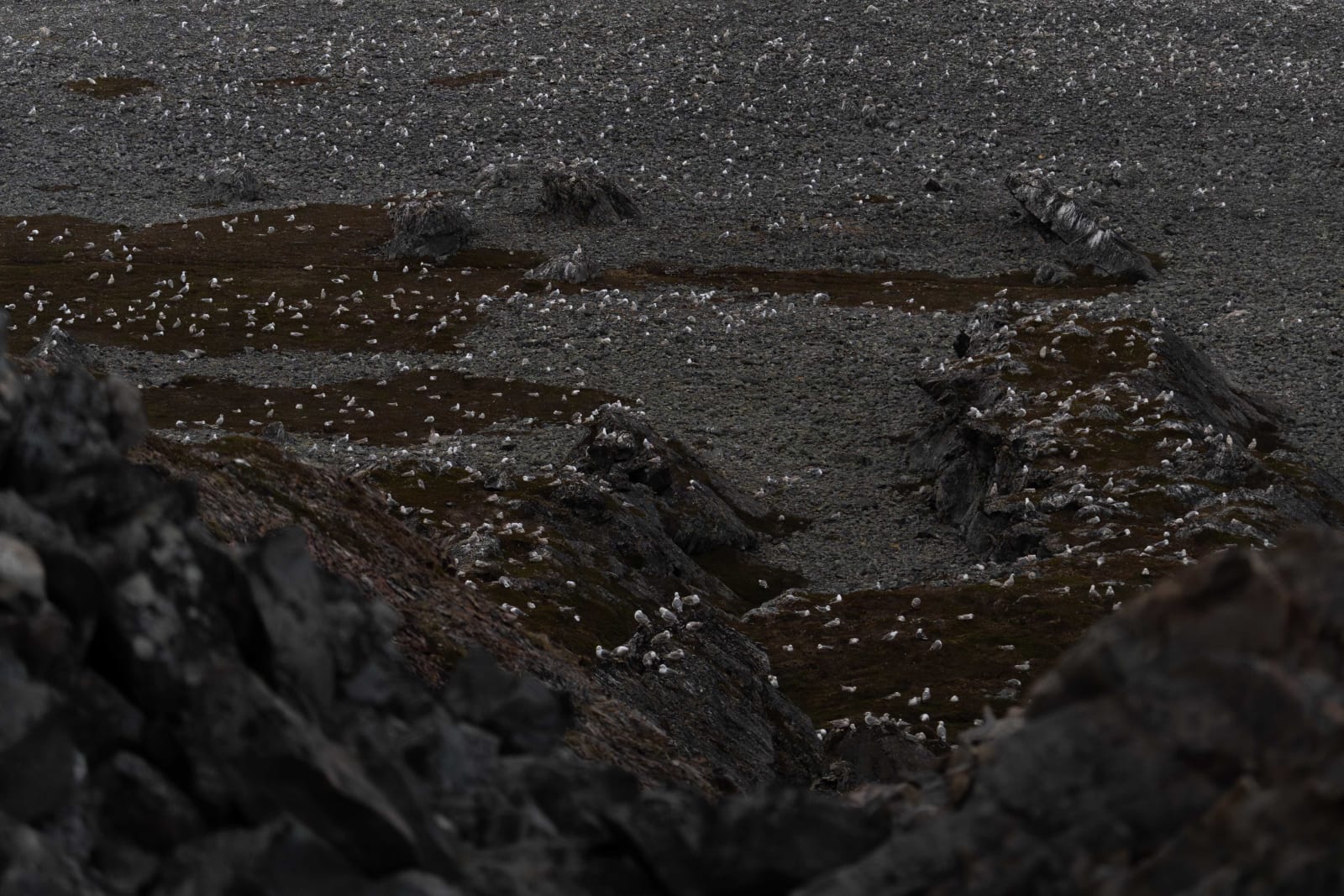
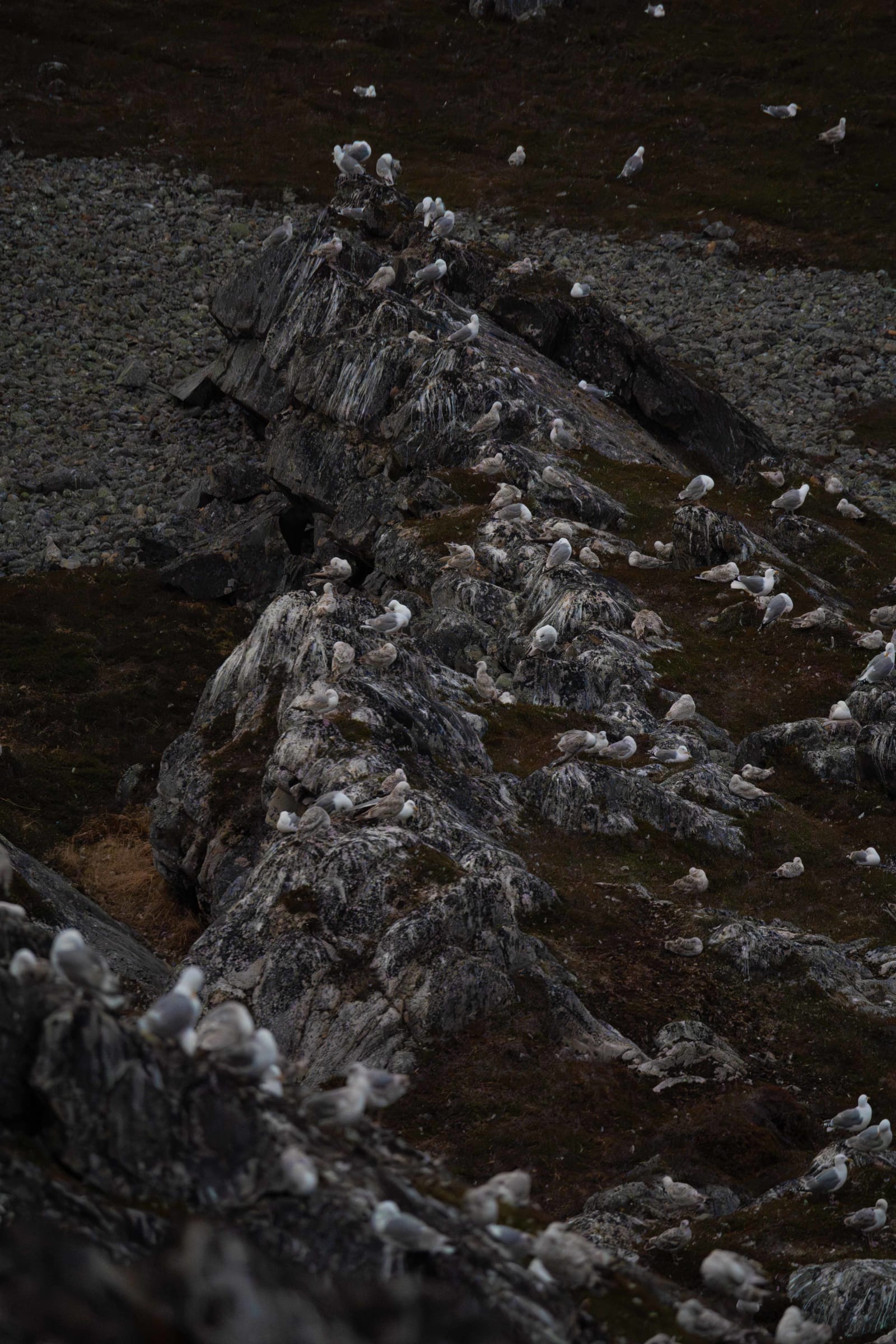
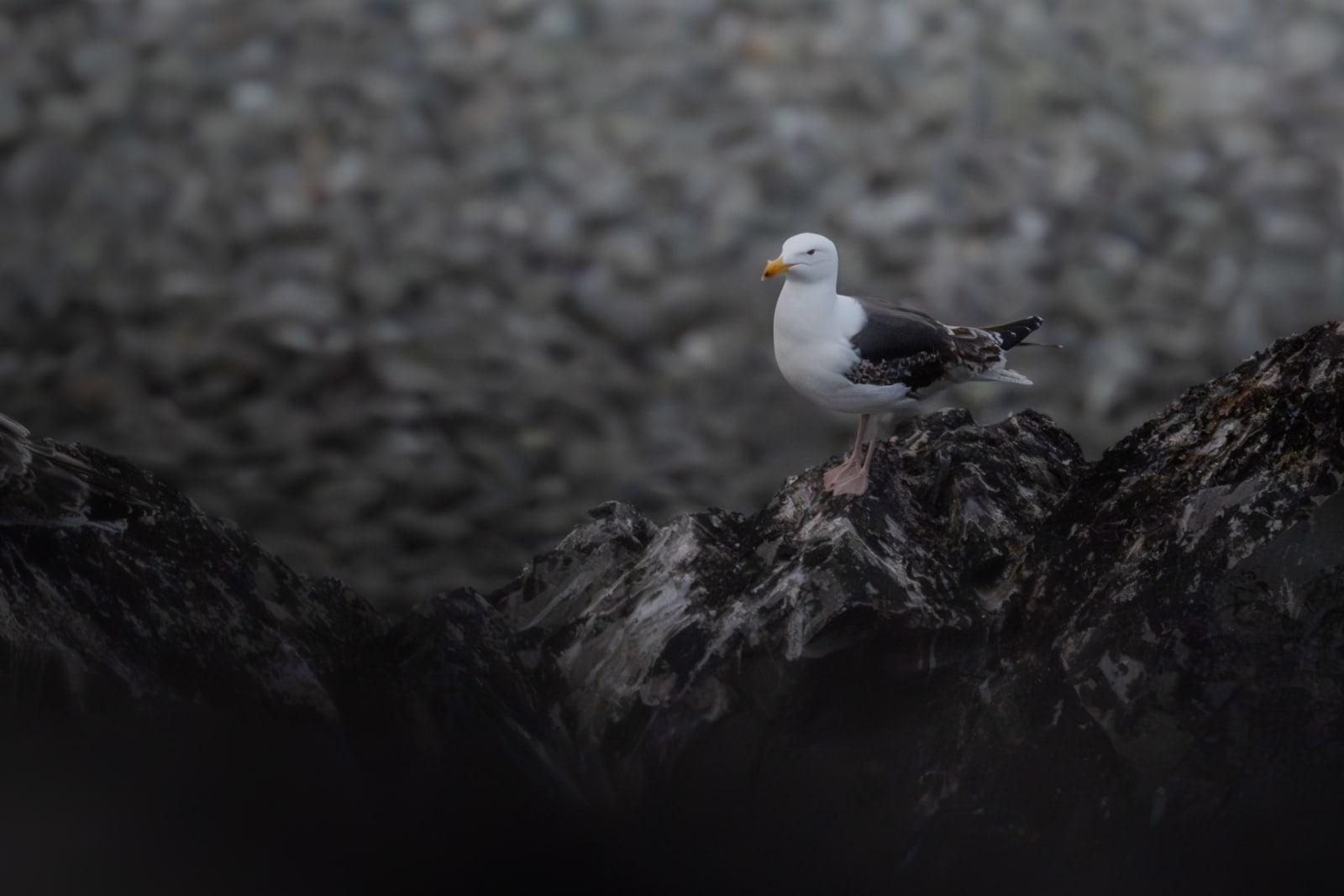
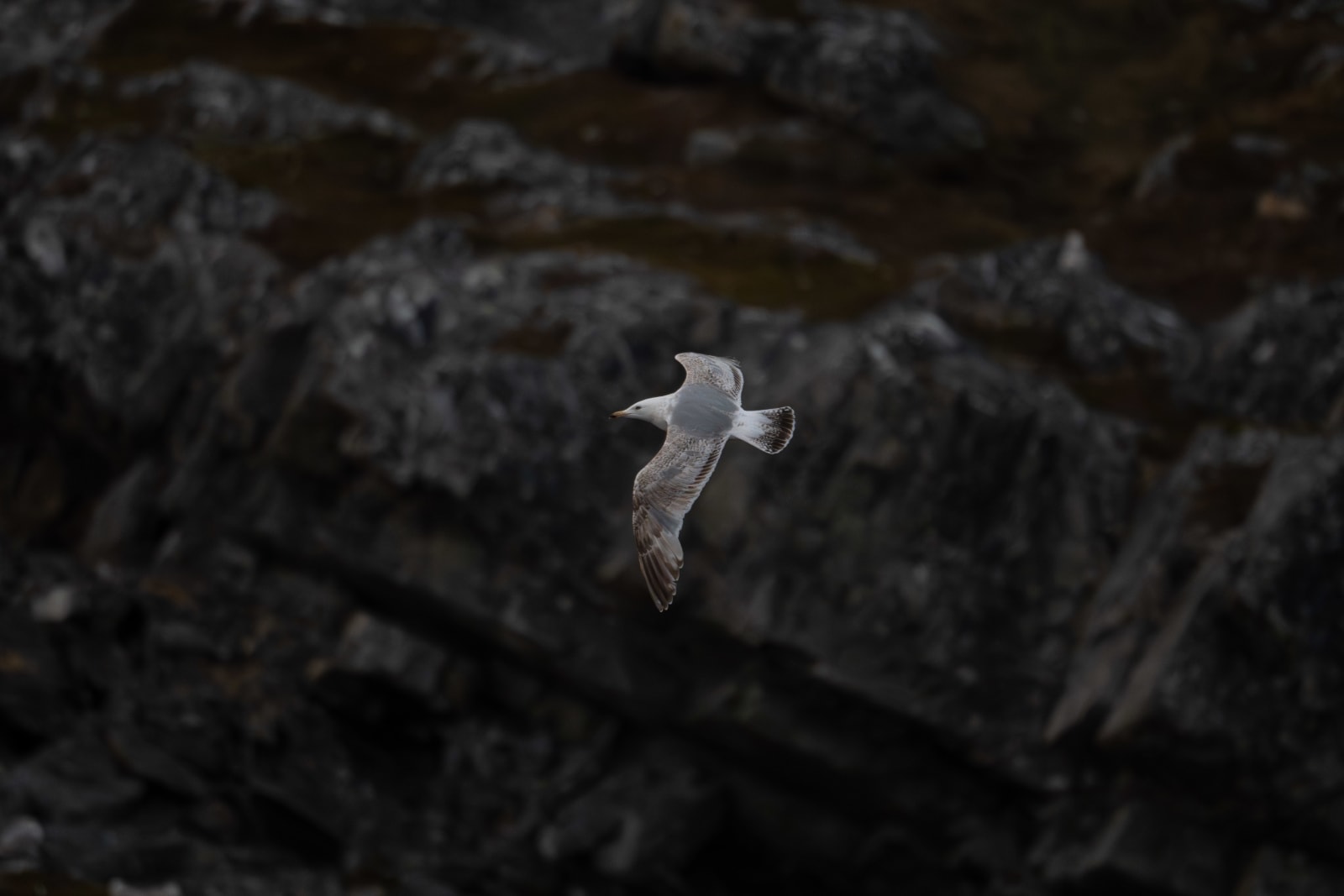
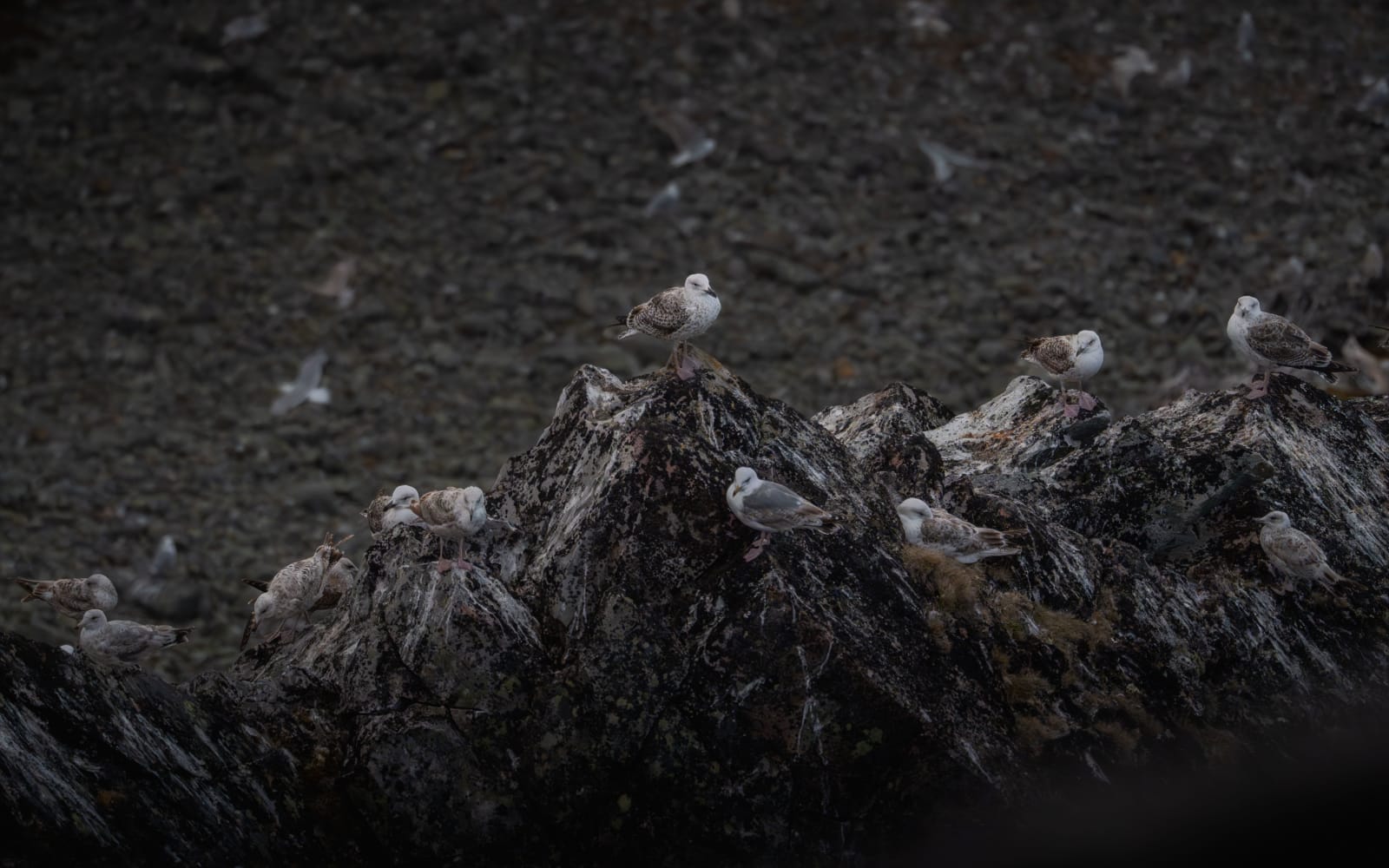
            <p>This summer I met a large flock of gulls (mainly herring gulls and great black-backed gulls) on the beach in Hamningberg, where they blend in perfectly with their moon-like surroundings.</p>
<p>It was incredible to sit and observe this man wild seabirds in their natural element, and it left me wondering <em>how many</em> gulls we saw that night exactly. So when I came home, I went through my pictures and counted.</p>

          
          <div class="size-s">
<p>This summer, in June, we spent a night in Hamningberg, a small village at the end of the road along the coast of Varanger.</p>
<p>Hamningberg is maybe best known for the otherworldly landscapes and the scenic road leading to the town, and it has an interesting history as well, being one of the only towns not burned down by the Germans during the Second World War.</p>
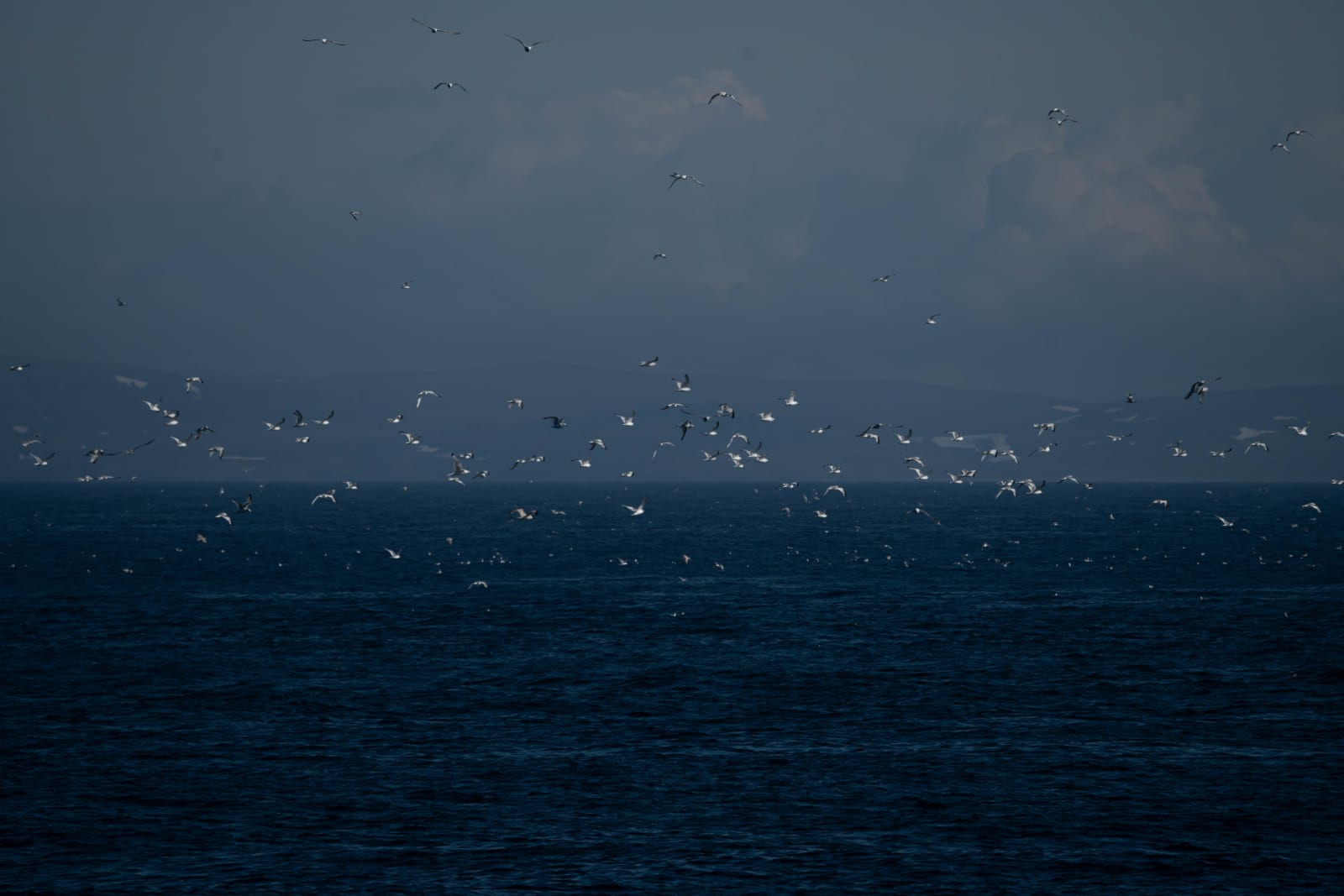
<p>But what fascinated me the most this trip, and what made our evening there a highlight of our summer, was the the incredibly high amount of gulls hunting and roosting along the shoreline.</p>
</div>
<div class="size-l">
<div class="collection-photos container size-l">
<div class="collection-grid" data-stretch="" data-size="" data-type="large" data-alignment="center" data-shape="normal" data-stretch="">
<div>
<a href="/photos/catalog/2024-06-16-hamningberg/gulls-beach-1/">
<img class="main-image" src="https://res.cloudinary.com/dy8r02i02/image/upload/f_auto,w_1900,c_scale/gulls-beach-1" alt="Zoomed in picture of a rocky beach with mountains on either side, and thousands of herring gulls and great black-backed gulls (mostly juveniles/below 4yo) all over the beach, showing up as little white dots against the gray rocks." />
</a>
</div>
<div>
<a href="/photos/catalog/2024-06-16-hamningberg/hamningberg-gulls-1/">
<img class="main-image" src="https://res.cloudinary.com/dy8r02i02/image/upload/f_auto,w_1900,c_scale/hamningberg-gulls-2" alt="Zoomed in picture of a large flock of herring gulls (mostly juveniles, and some adilts) standing on top of a rocky landscape with moss and grass growing between the rocks. There&#39;s white poop on the rocks, letting the gulls blend in perfectly." />
</a>
</div>
</div>
</div>
</div>
<div class="size-s container">
<p>We were lucky, because there was a lot of whale activity in the area while we were visiting. And where there are whales there’s fish, which means the gulls follow as well.</p>
</div>
<div class="size-s">
  <div class="container">
<p><a href="/photos/catalog/2024-06-16-hamningberg/gulls-sea-1/"></p>
  <img class="main-image" src="https://res.cloudinary.com/dy8r02i02/image/upload/f_auto,w_1900,c_scale/hamningberg-gulls-sea" alt="Very large group of gulls flying over the blue ocean, with mountains and clouds in the background, on a very sunny day." />
<p></a></p>
</div>
</div>
<div class="size-s container">
<p>I had read a lot about a rich bird life in the area, but we visited Hamningberg a few times before and could honestly not remember seeing that many birds there the preview years, so the show we got this year was a welcome surprise.</p>
</div>
<div class="size-m">
  <div class="container">
<p><a href="/photos/catalog/2024-06-16-hamningberg/hamningberg-gulls-beach-1/"></p>
  <img class="main-image" src="https://res.cloudinary.com/dy8r02i02/image/upload/f_auto,w_1900,c_scale/Hamningberg-gulls-beach-1" alt="A huge flock of herring gulls flying off simultaneously, on a very rocky landscape by tghe beach, photographed from above." />
<p></a></p>
</div>
</div>
<div class="size-s container">
<p>During our evening walk, we followed the perletur hiking trail up to Hardbaken, where we were greeted with the sight of hundreds, (or thousands?), of herring gulls and great black-backed gulls roosting along the rocky hills and beach, while other flocks of gulls were still following the whales at sea for a late night snack.</p>
<p>We were already impressed by the amount of gulls sitting on the side of the rocks and in the grass, and were completely blown away when we noticed an additional sea of gulls gathered on the stone beach, blending in perfectly with their environment.</p>
</div>
<div class="size-l">
<div class="collection-photos container size-l">
<div class="collection-grid" data-stretch="" data-size="" data-type="medium" data-alignment="center" data-shape="square" data-stretch="">
<div>
<a href="/photos/catalog/2024-06-23-varanger/svartbak/">
<img class="main-image" src="https://res.cloudinary.com/dy8r02i02/image/upload/f_auto,w_1900,c_scale/svartbak-varanger-1" alt="Near-adult great black-backed gull standing on a rocky coastline, blending in well with its environment. The GBBG is a large gull, with pink feet and black wings, and this indivisual still has some white/brown juvenile feathers left on the wings." />
</a>
</div>
<div>
<a href="/photos/catalog/2024-06-23-varanger/herring-gull/">
<img class="main-image" src="https://res.cloudinary.com/dy8r02i02/image/upload/f_auto,w_1900,c_scale/herring-gull-varanger-1" alt="Herring gull in flight, with a rocky shoreline as the backdrop. The herring gull is not fully adult yet and still has some brown and white spotted feathers on the wings, along with the gray adult feathers." />
</a>
</div>
<div>
<a href="/photos/catalog/2024-06-16-hamningberg/hamningberg-gulls-2/">
<img class="main-image" src="https://res.cloudinary.com/dy8r02i02/image/upload/f_auto,w_1900,c_scale/hamningberg-gulls-1" alt="Zoomed in picture of a large flock of herring gulls (mostly juveniles, and some adilts) standing on top of a rocky landscape with moss and grass growing between the rocks. There&#39;s white poop on the rocks, letting the gulls blend in perfectly." />
</a>
</div>
</div>
</div>
</div>
<div class="size-s container">
<p>It left us wondering: how many gulls were we actually looking at?</p>
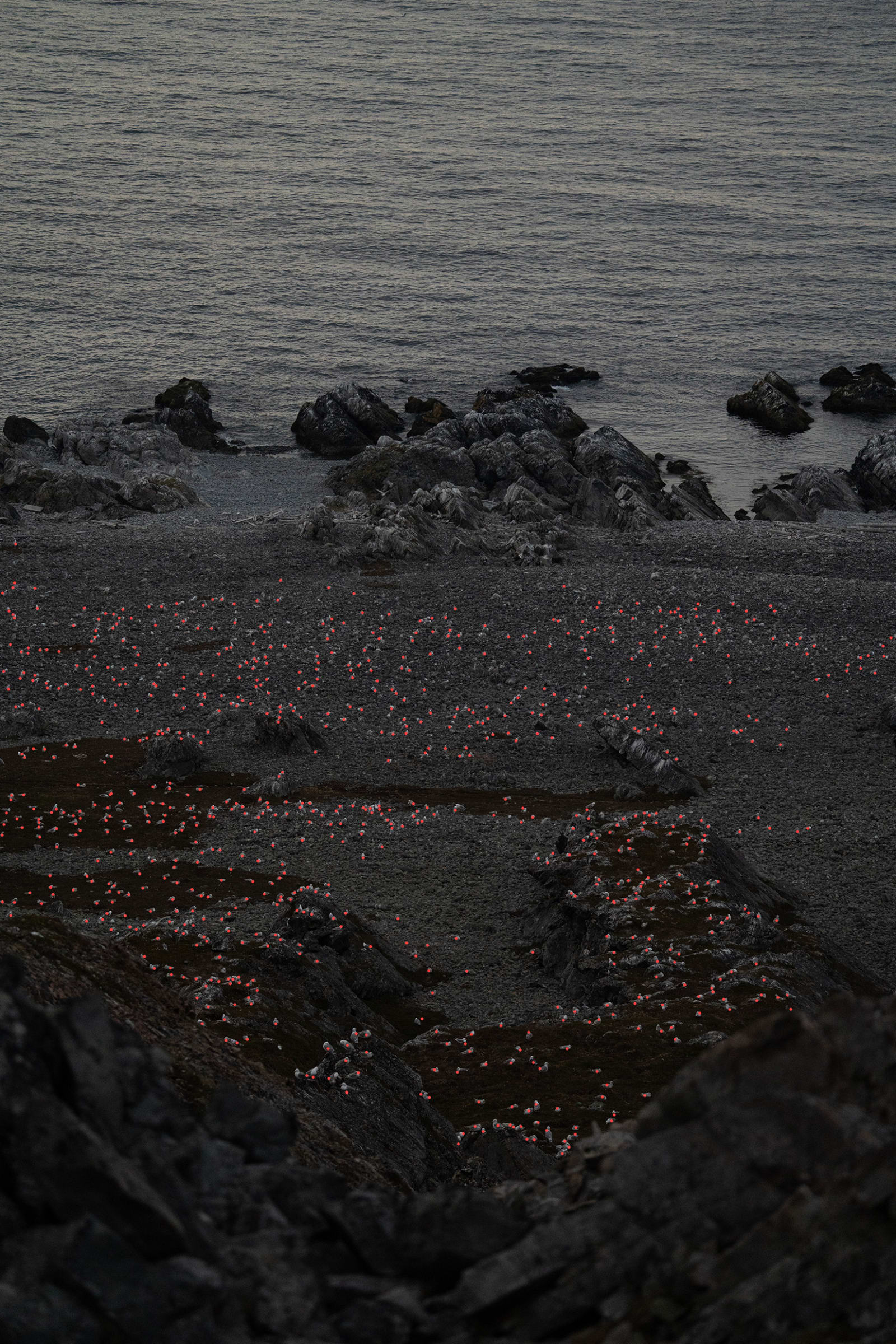
<p>So I took a “wide” angle picture (35mm) of the view from the spot where we were sitting, opened it in photoshop, and started counting.</p>
</div>
<div class="size-l">
  <div class="container">
<p><a href="/photos/catalog/2024-06-16-hamningberg/hamningberg-overview-1/"></p>
  <img class="main-image" src="https://res.cloudinary.com/dy8r02i02/image/upload/f_auto,w_1900,c_scale/hamningberg-overview-1" alt="Wide picture of a rocky beach with mountains on either side, and thousands of herring gulls and great black-backed gulls (mostly juveniles/below 4yo) all over the beach, showing up as little white dots against the gray rocks." />
<p></a></p>
</div>
</div>
<div class="size-s container">
<p>I used the brush tool with a bright red color, zooming into the picture and putting a dot on each gull I spotted. I started in a new transparent layer above the picture, and continued on a new layer after every 50 dots placed. Then at the end, I counted the amount of layers and multiplied them by 50 to know the total amount of gulls in the picture.</p>
</div>
<div class="size-l container">
<img src="https://res.cloudinary.com/dy8r02i02/image/upload/f_auto,w_1900,c_scale/hamningberg-count-1707_gcs6wr" alt="wide angle picture of a rocky coastline with thousands of herring gulls on them, a small red dot is placed on each of the gulls" />
</div>
<div class="size-s container">
<h2>Nearly 2000 gulls on this picture</h2>
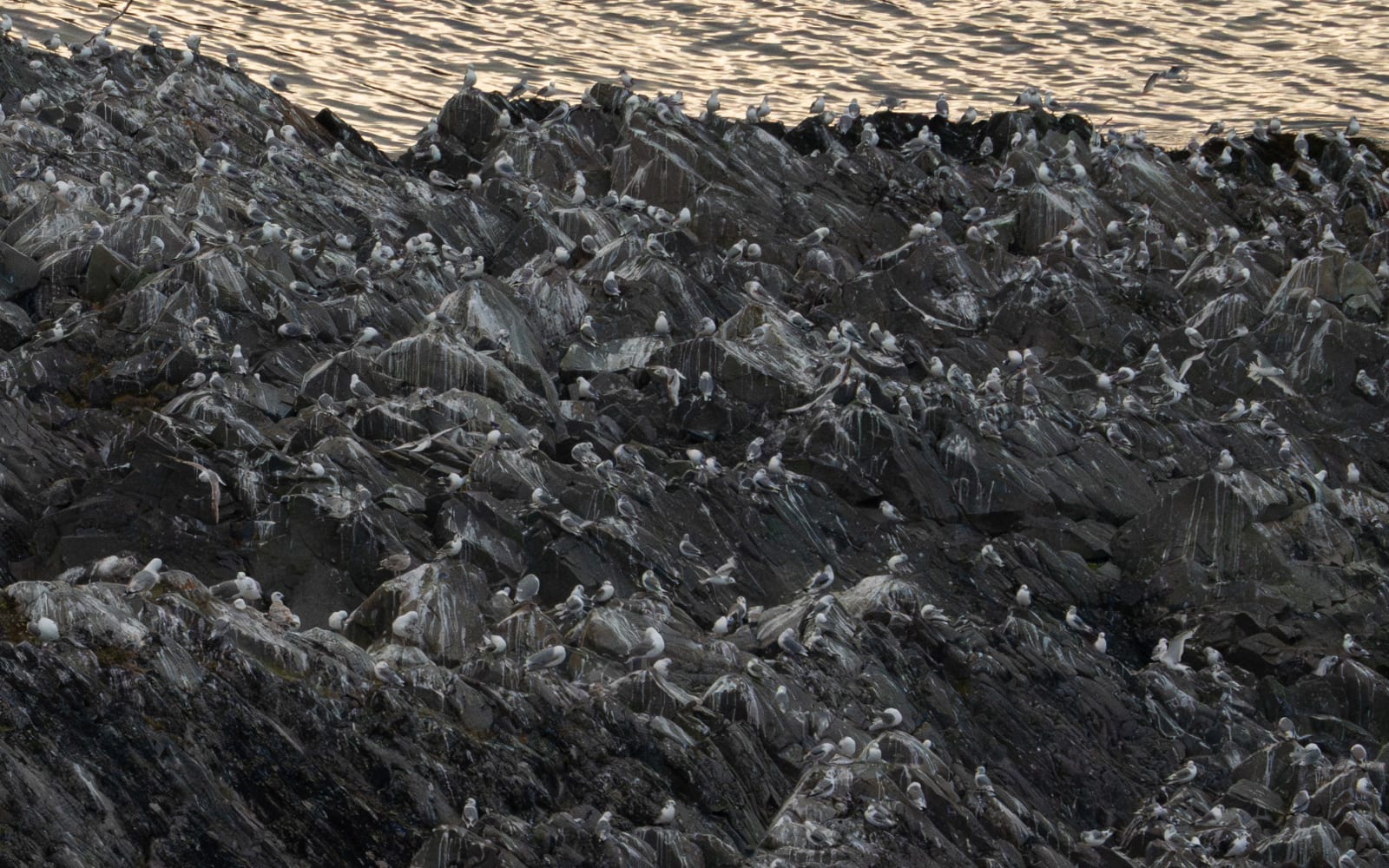
<p>And I counted… 1707 gulls on the wide angle picture, and an additional 183 on the picture that’s zoomed in on one of the rocks by the water, bringing it to a total of <strong>1890 gulls</strong> that are identifiable in these two pictures.</p>
<p>I also compared an area of the wide angle picture above to a zoomed in picture of the same area (the grass and the beach below), and ended up counting more or less the same amount of gulls, although there are still dots left of which I'm unsure whether they're a gull or just discolored rock.</p>
</div>
<div class="size-m container grid" data-type="large">
  <img src="https://res.cloudinary.com/dy8r02i02/image/upload/f_auto,w_1900,c_scale/hamningberg-count-183_knhvfq" alt="wide angle picture of a rocky coastline with thousands of herring gulls on them, a small red dot is placed on each of the gulls" />
  <img src="https://res.cloudinary.com/dy8r02i02/image/upload/f_auto,w_1900,c_scale/hamningberg-count-773_coycfj" alt="wide angle picture of a rocky coastline with thousands of herring gulls on them, a small red dot is placed on each of the gulls" />
</div>
<div class="size-s container">
<p>I’m sure there was a substantial amount more than 1890 on this patch of beach. I didn’t take zoomed in pictures of all the rocks in the distance, and the wide angle picture is just too zoomed out to be able to reliably count them, so I didn’t.</p>
<p>My guess is there are around 2000 in the wide picture including those that were too far away to count, potentially closer to 2500 or even 3000 if all the white dots around the lighthouse area are birds too (I think it’s just discoloured from droppings, from what I remember).</p>
</div>
<div class="size-s container">
<h2>A lot more gulls in Hamningberg</h2>
<p>There were also a lot more gulls overnighting in the area than displayed in this picture. The beach stretches on like this both on the left and right, and it seemed like gulls were overnighting all along the coastline. Additionally, large groups of gulls kept following the whales at sea as well.</p>
<p>If the area in the wide angle picture has nearly 2000 gulls on them, then I think the total amount of gulls we saw that night must have been at least 10,000.</p>
</div>
<div class="size-l container">
<div class="collection-photos container size-l">
<div class="collection-grid" data-stretch="" data-size="" data-type="large" data-alignment="center" data-shape="normal" data-stretch="">
<div>
<a href="/photos/catalog/2024-06-16-hamningberg/hamningberg-lighthouse-gulls/">
<img class="main-image" src="https://res.cloudinary.com/dy8r02i02/image/upload/f_auto,w_1900,c_scale/hamningberg-lighthouse-gulls" alt="Lighthouse stnanding on gray rocks by the coast, with a large group of herring gulls flying around it." />
</a>
</div>
<div>
<a href="/photos/catalog/2024-06-16-hamningberg/hamningberg-gold-light/">
<img class="main-image" src="https://res.cloudinary.com/dy8r02i02/image/upload/f_auto,w_1900,c_scale/hamningberg-gold-light" alt="Gray rocks with white poop on them, by the ocean which is lid orange by the evening light. The rocks are covered with herring gulls, which blend in perfectly with their gray and white colors." />
</a>
</div>
</div>
</div>
</div>
<div class="size-s container">
<p>Seeing so many wild and strong gulls in their natural environment was an incredible experience, and one I want to come back for. Looking forward to my next trip to Hamningberg. 🥰</p>
</div>
        ]]>
      </content>
    </entry>
  
    <entry>
      <title>I finally launched my photo portfolio &amp; blog</title>
      <link href="https://fossheim.photography/blog/2024-08-04-new-blog" />
      <updated>2024-08-04T00:00:00.000Z</updated>
      <id>https://fossheim.photography/blog/2024-08-04-new-blog"</id>
      <content type="html"><![CDATA[
          
          
            <p>I've wanted to develop my own photo blog since 2019, and this summer I finally got around to do it. It's nice sharing photography to social media, like Mastodon or Instagram, for the community aspect of it, but I was really missing a space I could call my own.</p>

          
          <p>I spend a lot of my spare time bird watching, out taking pictures, or in editing pictures. And a lot of those pictures over time have just ended up on a hard drive.</p>
<p>I've printed some to hang in our apartment, we're creating photobooks for all of our trips (although I am lagging several trips behind 😅), and some get posted to Instagram, Mastodon, and Flickr, but I felt like none of that really does justice to the amount of time and passion I put into my work.</p>
<p>I wanted a place where I could have complete freedom over how I present my pictures, and where I could focus on text-content in addition.</p>
<h2>Focus on the wildlife</h2>
<p>An important &quot;feature&quot; for me is the ability to focus on the species I photograph. All my photos, albums, and blog posts are <a href="/species">collected by species</a>. Each species has its own detail page, where I can include additional information about the species as well.</p>
<h2>Everything is connected</h2>
<p>All of the <a href="/photos/all/">photos</a> have their own page, but can also be:</p>
<ul>
<li>added to <a href="/collections">collections/photo albums</a>,</li>
<li>connected to <a href="/species">species</a>,</li>
<li>mentioned in <a href="/blog">blog posts</a></li>
</ul>
<h2>Everything is customizable</h2>
<p>All colors, grids, and layouts are customizable on page level. For example, this <a href="/photos/catalog/2024-03-01-winter-oslo/herring-gull-bw/">herring gull has a matching black background</a> or <a href="/photos/catalog/2024-04-09-varanger/kittiwake-in-red/">this kittiwake with the matching red accent color</a>. <a href="/collections/gulliver-josefine/photos/">Gulliver &amp; Josefine's pictures</a> are presented in large format where there's a lot of focus on each picture, whereas my <a href="/collections/location-finnmark/photos/">Finnmark album</a> gives more of a birds eye view.</p>
<p>It may sound like a useless feature, but I had a lot of fun building it, and enjoy being able to customize how I present my content.</p>
<h2>Subscribe to RSS</h2>
<p>Some gulls have their own Instagram account, mine have <a href="/collections/gulliver-josefine/feed.xml">their own RSS feed</a> 🤓.</p>
<p>My website's <a href="/feed.xml">main RSS feed</a> collects all photos and blog posts. Additionally it's also possible to subscribe to <a href="/photos/feed.xml">just the photos</a>, just the <a href="/blog/feed.xml">blog posts</a>, or each of the collections and species.</p>
<p>Maybe you're particularly invested in <a href="/collections/gulliver-josefine/feed.xml">Gulliver &amp; Josefine's story</a> or want to follow along <a href="/collections/location-finnmark/feed.xml">our adventures in the north</a>? Or maybe you only want to see auks like <a href="/species/fraterculaarctica/feed.xml">puffins</a> or <a href="/species/uriaaalge/feed.xml">murres</a>, or get notifications for new <a href="/species/rissatridactyla/feed.xml">kittiwake</a> content? It's possible to subscribe to any of the collections and species by adding <code>feed.xml</code> at the end of their URL.</p>
<h2>Made with <a href="https://www.11ty.dev/">Eleventy</a></h2>
<p>I'll probably write about how I built the website on my <a href="https://fossheim.io/writing/">tech blog</a>, but to get a bit technical here as well: I write all the content in markdown format and use <a href="https://www.11ty.dev/">Eleventy</a> &amp; JavaScript in the background to turn this into static HTML &amp; CSS files.</p>
<p>This set-up gives me a lot of flexibility over the layout and data, without having to load a lot of <em>(currently no)</em> JavaScript code in the browser. It also lets me keep ownership over my content, which is a huge plus for me.</p>
<h2>What's to come?</h2>
<p>Amongst the updates I'm planning for the website are:</p>
<ul>
<li>Improving the size and loading speed of the images</li>
<li>Observation log</li>
<li>Collection types and filters</li>
<li>Photo types and filters</li>
<li>Browse by location</li>
<li>Browse by gear</li>
</ul>
<h2>Spot an issue?</h2>
<p>This website is a living document and as a result a forever work-in-progress. If you encounter any bugs, weird UX, or accessibility issues, please reach out to me on <a href="https://mastodon.art/@fosstography">Mastodon</a>, <a href="https://instagram.com/fossheim.photography">Instagram</a>, or <a href="mailto:hi@fossheim.photography">e-mail</a>.</p>

        ]]>
      </content>
    </entry>
  
    <entry>
      <title>What we know about &quot;our&quot; herring gull Josefine</title>
      <link href="https://fossheim.photography/blog/2024-08-01-josefine" />
      <updated>2024-08-01T00:00:00.000Z</updated>
      <id>https://fossheim.photography/blog/2024-08-01-josefine"</id>
      <content type="html"><![CDATA[
          
          
            <p>For a while now, two herring gulls have been &quot;living&quot; on our rooftop balcony. Before that they lived on a chimney across the street. We called the male Gulliver, and the female Josefine. Josefine has a color ring around her leg, which is registered in an online database where we can see past observations of her.</p>

          
          <h2>She's at least 13 years old</h2>
<p>She received her ring in January of 2016 as an adult, 5 years or older. This means she hatched in or before 2011, and at least 13 years old at the time of writing. It's not possible to age gulls once they reach adulthood, so she could be anything from 13 to 30 years or older (the oldest herring gull recorded is <a href="https://genomics.senescence.info/species/entry.php?species=Larus_argentatus">49 years old</a>).</p>
<h2>She has been frequenting our area for at least 8 years</h2>
<p>Ever since she received her ring, she's been consistently observed in the parks around our area, and several times right down the street from us. There are a few exceptions. Like the rest of our herring gull flock she breeds outside the city center, and she has occasionally been observed at other gull hotspots.</p>
<p>I've seen her on the neighbor's chimney since at least February 2023, when I first started taking pictures of the gulls in our street, and she's been frequenting our balcony since February 2024. The gulls where already on the chimney's before February 2023 (that's just when I started following along with them), and most of them around here seem to return to their exact same spot every day, so I think it'sw safe to say she's been living on these roofs for a <em>long</em> time.</p>
<div class="collection-photos container size-l">
<div class="collection-grid" data-stretch="" data-size="" data-type="medium" data-alignment="center" data-shape="normal" data-stretch="">
<div>
<a href="/photos/catalog/2024-07-31-grünerløkka/josefine-2/">
<img class="main-image" src="https://res.cloudinary.com/dy8r02i02/image/upload/f_auto,w_1900,c_scale/DSC04515-Enhanced-NR_ltyz9s" alt="Adult herring gull looking straight at the camera, with a stern look on her face. Another gull is standing out of focus in front of her, and the background is a blue-ish out of focus color." />
</a>
</div>
<div>
<a href="/photos/catalog/2024-07-31-grünerløkka/josefine-1/">
<img class="main-image" src="https://res.cloudinary.com/dy8r02i02/image/upload/f_auto,w_1900,c_scale/DSC04677-Enhanced-NR-2_cw4cvo" alt="Adult herring gull looking at the camera from behind a diagonal roof." />
</a>
</div>
</div>
</div>
<h2>Often observed with the same gulls</h2>
<p>Ever since she first appeared in my pictures, she's been together with the same gull, who we called Gulliver. He's the one who first made the move from the chimney to the balcony, and the one who caused us to really start following along with the comings and goings of the flock.</p>
<h3>Gulliver</h3>
<p>Gulliver and Josefine are clearly a couple, doing everything toghether. When he's out looking for food, she patiently waits for him on top of our chimney, and while she's gone he patrols the balcony wall, and when they spot eachother in the distance they call out to eachother with excitement, <em>loudly</em>. Gulliver seems to be very protective over Josefine, chasing other gulls away from her and also guarding her while she's eating.</p>
<div class="collection-photos container size-l">
<div class="collection-grid" data-stretch="" data-size="" data-type="medium" data-alignment="center" data-shape="normal" data-stretch="">
<div>
<a href="/photos/catalog/2024-03-01-winter-oslo/gulliver-snow-1/">
<img class="main-image" src="https://res.cloudinary.com/dy8r02i02/image/upload/f_auto,w_1900,c_scale/53560518908_1f91e46abe_k_kbkoxj" alt="Portrait of a European Herring Gull in a snow storm. The picture is zoomed in on his face, the background is an out of focus hazy dark purple/gray, and there&#39;s snow falling around the gull. He&#39;s in adult winter plumage, white body with gray stripes on the head and around the eyes." />
</a>
</div>
<div>
<a href="/photos/catalog/2024-03-01-winter-oslo/gulliver-snow-2/">
<img class="main-image" src="https://res.cloudinary.com/dy8r02i02/image/upload/f_auto,w_1900,c_scale/DSC03862-Enhanced-NR-10_ybfjt1" alt="Portrait of a European Herring Gull in a snow storm. The picture is zoomed in on his face, the background is an out of focus hazy dark purple/gray, and there&#39;s snow falling around the gull. He&#39;s in adult winter plumage, white body with gray stripes on the head and around the eyes." />
</a>
</div>
</div>
</div>
<h3>JMT80</h3>
<p>I don't have any pictures of JMT80 (or Jean-Marie, as we call him) uploaded yet, but he's one of the few gulls who's <em>occasionally</em> allowed to visit the roof while Gulliver &amp; Josefine are there. He received his ring in 2022 as a 5+, so he's at least in his 7th year currently, and breeds on the same island as Gulliver &amp; Josefine.</p>
<p>He's really not afraid of a battle, and I think one of the reasons they tolerate him on &quot;their&quot; roof is because they don't have a choice.</p>
<h3>JLN44</h3>
<p>In her observations, some of the other neighborhood gulls their numbers have been mentioned as well, and vice versa.</p>
<p>One of them is JLN44, aka Julien, who's at least 9. He was here the first time Gulliver was on the roof. He has visited a handful of times together with Gulliver &amp; Josefine since then, and he occasionally gets observed in the nearby park as well.</p>
<div class="container">
<p><a href="/photos/catalog/2024-03-01-winter-oslo/jln44-snow-1/"></p>
  <img class="main-image" src="https://res.cloudinary.com/dy8r02i02/image/upload/f_auto,w_1900,c_scale/53298378553_0af1ebf9b4_k_bspfeq" alt="Adult herring gull in winter plumage, standing on a chimney, surrounded by snow." />
<p></a></p>
</div>
<h2>She has been to prison...</h2>
<p>Amongst the observations of her, one of them was at the prison not far away from here. It's a popular spot for gulls since there's food to be had in the park next to it, but I'd like to believe she had to spend the night in jail for being a bad gull 🤭</p>

        ]]>
      </content>
    </entry>
  
    <entry>
      <title>Introduction to Gulliver and Josefine, our rooftop gulls</title>
      <link href="https://fossheim.photography/blog/2024-07-24-introduction" />
      <updated>2024-07-24T00:00:00.000Z</updated>
      <id>https://fossheim.photography/blog/2024-07-24-introduction"</id>
      <content type="html"><![CDATA[
          
          
            <p>Gulliver and Josefine are a couple of, assumibly rather old, herring gulls that live on the roodtops in our street.</p>
<p>The ledge of our balcony is one of their favorite hangout spots, along with the chimney of the building across the street. We've been observing and following along with them for quite a while, and they've been enjoying watching us just as much.</p>

          
          <div class="size-s">
<p>I had seen the herring gulls in Oslo before, but never paid much attention to them or realized how much personality they actually had until I moved to an apartment where we got a front-row seat to the comings and goings of the neighborhood gulls.</p>
<p>We live close to a small park and not far away from a river, so there are quite a bit of gulls hanging out in our neighborhood, and a lot of them are repeat daily visitors. When they're not hunting or foraging for food, they relax on the chimneys and roofs in the area. And as it turns out, most of them have their own spot, to which they return every single day at sunrise.</p>
<h2>How it all started</h2>
<p>Two of those gulls are Gulliver and Josefine. They were living on the chimney across the street until October 2023, when Gulliver decided to check out our balcony while I was photographing a crow visitor. He liked what he saw, and has since then traded the neighbor's chimney for the ledge of our balcony, from where he has a view on the street, the sky, and our apartment.</p>
<p>Josefine was a lot more skeptical at first and it took him some convincing, but during early spring she &quot;moved in&quot; with him on our balcony ledge.</p>
<p>I've been following their life quite closely since his first he first stopped by, and they inspired me to start this blog, since I wanted to document their interesting behaviors, intelligence, beautiful dynamics, and rich personalities somewhere.</p>
</div>
<div class="collection-photos container size-l">
<div class="collection-grid" data-stretch="" data-size="" data-type="medium" data-alignment="center" data-shape="normal" data-stretch="stretch">
<div>
<a href="/photos/catalog/2024-03-01-winter-oslo/gulliver-snow-2/">
<img class="main-image" src="https://res.cloudinary.com/dy8r02i02/image/upload/f_auto,w_1900,c_scale/DSC03862-Enhanced-NR-10_ybfjt1" alt="Portrait of a European Herring Gull in a snow storm. The picture is zoomed in on his face, the background is an out of focus hazy dark purple/gray, and there&#39;s snow falling around the gull. He&#39;s in adult winter plumage, white body with gray stripes on the head and around the eyes." />
</a>
</div>
<div>
<a href="/photos/catalog/2024-03-01-winter-oslo/josefine-snow-1/">
<img class="main-image" src="https://res.cloudinary.com/dy8r02i02/image/upload/f_auto,w_1900,c_scale/53625606594_11f28cfeae_k_rjiuh8" alt="Adult herring gull in breeding plumage, looking at the camera, with snow falling around her." />
</a>
</div>
</div>
</div>
<div class="size-s container">
<h2>Josefine</h2>
<p>Even though Josefine started visiting much later than Gulliver, we do know more about her. She has a color ring around her leg, which lets us register and read observations of her.</p>
<p>She received the ring in January of 2016, as an adult in her 5th calendar year or higher. It's not possible to tell the age of gulls once they've reached adulthood, so &quot;at least 5 years&quot; is as precise as the data gets. This makes her at least 13 years old, but we suspect she and Gulliver are both older than that.</p>
<p>We also know where she's been over the years, and she has a clear preference: she's been consistently observed in our area, with a few exceptions. For example, she and Gulliver breed outside the city center.</p>
</div
<div class="container">
<div class="collection-photos container size-l">
<div class="collection-grid" data-stretch="" data-size="" data-type="medium" data-alignment="center" data-shape="square" data-stretch="stretch">
<div>
<a href="/photos/catalog/2024-03-01-winter-oslo/josefine-portrait-1/">
<img class="main-image" src="https://res.cloudinary.com/dy8r02i02/image/upload/f_auto,w_1900,c_scale/DSC05846-Enhanced-NR-2_jq5izl" alt="Adult herring gull in breeding plumage, looking at the camera, with a different gull standing out of focus in the foreground." />
</a>
</div>
<div>
<a href="/photos/catalog/2024-07-31-grünerløkka/josefine-2/">
<img class="main-image" src="https://res.cloudinary.com/dy8r02i02/image/upload/f_auto,w_1900,c_scale/DSC04515-Enhanced-NR_ltyz9s" alt="Adult herring gull looking straight at the camera, with a stern look on her face. Another gull is standing out of focus in front of her, and the background is a blue-ish out of focus color." />
</a>
</div>
</div>
</div>
</div>
<div class="size-s container">
<h2>Gulliver</h2>
<p>Gulliver has been visiting us the longest, but we have no info about his age or which other places he visits, as he's not ringed. But we do know he spends a significant amount of time on our roof and two additional ones in our street.</p>
<p>He's a quite large and strong gull, good at defending his rooftops, a loving partner to Josefine, and... an eager people-watcher.</p>
<p>We often notice him standing on top of our windows, looking inwards into our apartment while making talking noises to Josefine. When he's on the balcony he follows along with what happens inside, and each morning he greets us with the loudest concert as soon as he notices we're awake.</p>
</div>
<div class="container">
<div class="collection-photos container size-l">
<div class="collection-grid" data-stretch="" data-size="" data-type="medium" data-alignment="center" data-shape="square" data-stretch="stretch">
<div>
<a href="/photos/catalog/2024-03-01-winter-oslo/gulliver-snow-1/">
<img class="main-image" src="https://res.cloudinary.com/dy8r02i02/image/upload/f_auto,w_1900,c_scale/53560518908_1f91e46abe_k_kbkoxj" alt="Portrait of a European Herring Gull in a snow storm. The picture is zoomed in on his face, the background is an out of focus hazy dark purple/gray, and there&#39;s snow falling around the gull. He&#39;s in adult winter plumage, white body with gray stripes on the head and around the eyes." />
</a>
</div>
<div>
<a href="/photos/catalog/2024-07-31-grünerløkka/gulliver-2/">
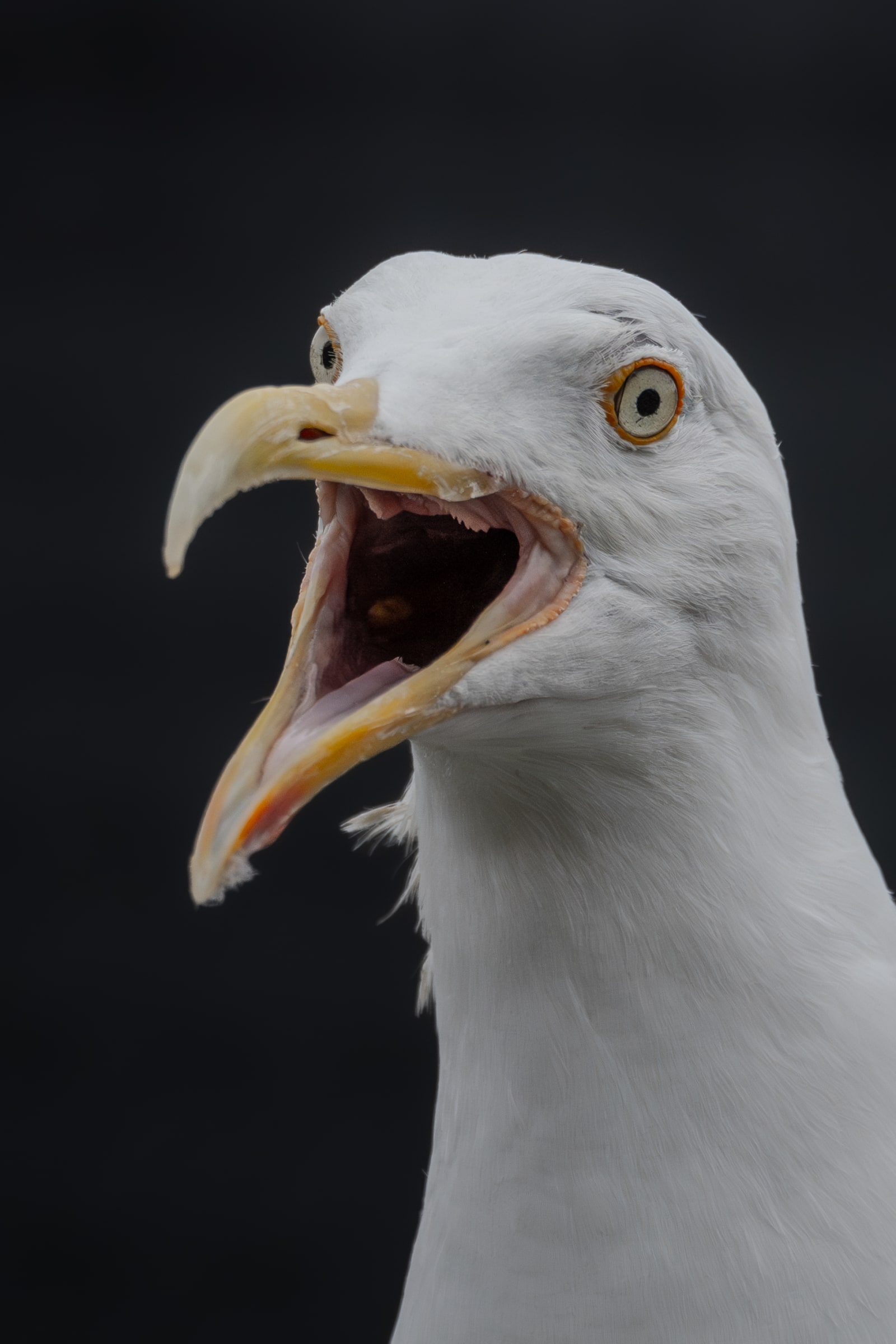
<img class="main-image" src="https://res.cloudinary.com/dy8r02i02/image/upload/f_auto,w_1900,c_scale/DSC04577-Enhanced-NR-2_x2qp9z" alt="Portrait of an adult herring gull shouting towards the camera. The background is black and out of focus, whereas the gull is in fous. He&#39;s moulting from summer to winter plumage, and looking a bit bald on the head as a result." />
</a>
</div>
<div>
<a href="/photos/catalog/2024-03-01-winter-oslo/gulliver-gradient-1/">
<img class="main-image" src="https://res.cloudinary.com/dy8r02i02/image/upload/f_auto,w_1900,c_scale/53353564759_7af894db2d_k_g0mmdj" alt="Adult herring gull in winter plumage. In the background there&#39;s a pink/red to gray gradient (out of focus house), in the foreground there&#39;s gold reflection from something, and the gull is outlined by gold late afternoon light." />
</a>
</div>
</div>
</div>
</div>
<div class="size-s container">
<h2>Their relationship</h2>
<p>Gulliver is a very confident and bossy gull (aren't they all though), that rarely tolerates other gulls on his roof. Josefine is the only exception, she's not only tolerated, she's highly encouraged by him to hang out together.</p>
<p>And they really do spend a lot of time with one another. They're typically sitting together, quietly (and occaisionally very loudly) talking to eachother. When Gulliver arrives on the balcony before her, he patiently waits for her, shouting out for her as soon as he notices her in the distance.</p>
<p>While eating they stand guard for eachother, and if we give Gulliver food while Josefine is not around, he calls out for her and leaves a (small) portion for her. Gulliver is definitely a tough one, who has seemed quite successful at protecting his long-term partner so far. The same can be said for Josefine, who fiercly chases away any other gulls showing interest in &quot;their&quot; roofs.</p>
<p>I honestly didn't fully realize that gulls were this social with eachother until I started following these two. They talk to eachother, they arrive together at sunrise and leave together at sunset, gather food for eachother, have their own territories even in the city, have certain other gulls they allow near, and some they passionately chase off.</p>
<h2>Next Gulliver &amp; Josefine blogs</h2>
<p>I take a lot of pictures of Gulliver &amp; Josefine, and spend a lot of time watching them, so as soon as I decided to create a place to share my photography, I knew I had to dedicate a section to them.</p>
<p>Besides sharing their portraits, I'm also hoping to document their behavior and interactions, and share little updates about what they're up to. We will be moving out of our apartment at some point within the next years as well, so more than anything I want to save some memories of our lovely friends.</p>
<p>All of my Gulliver and Josefine related blog posts and photos can be explored in my <a href="/collections/gulliver-josefine/">Gulliver &amp; Josefine collection</a>.</p>
<p><strong>Want to support my photography or buy our power couple some fish?</strong>
<br />→ Visit my <a href="https://ko-fi.com/fosstography">ko-fi page</a> 🎣✨</p>
</div>
        ]]>
      </content>
    </entry>
  
    <entry>
      <title>Rare bird 🚨 Smew at Østensjøvannet</title>
      <link href="https://fossheim.photography/blog/2024-03-01-smew" />
      <updated>2024-03-01T00:00:00.000Z</updated>
      <id>https://fossheim.photography/blog/2024-03-01-smew"</id>
      <content type="html"><![CDATA[
          
          
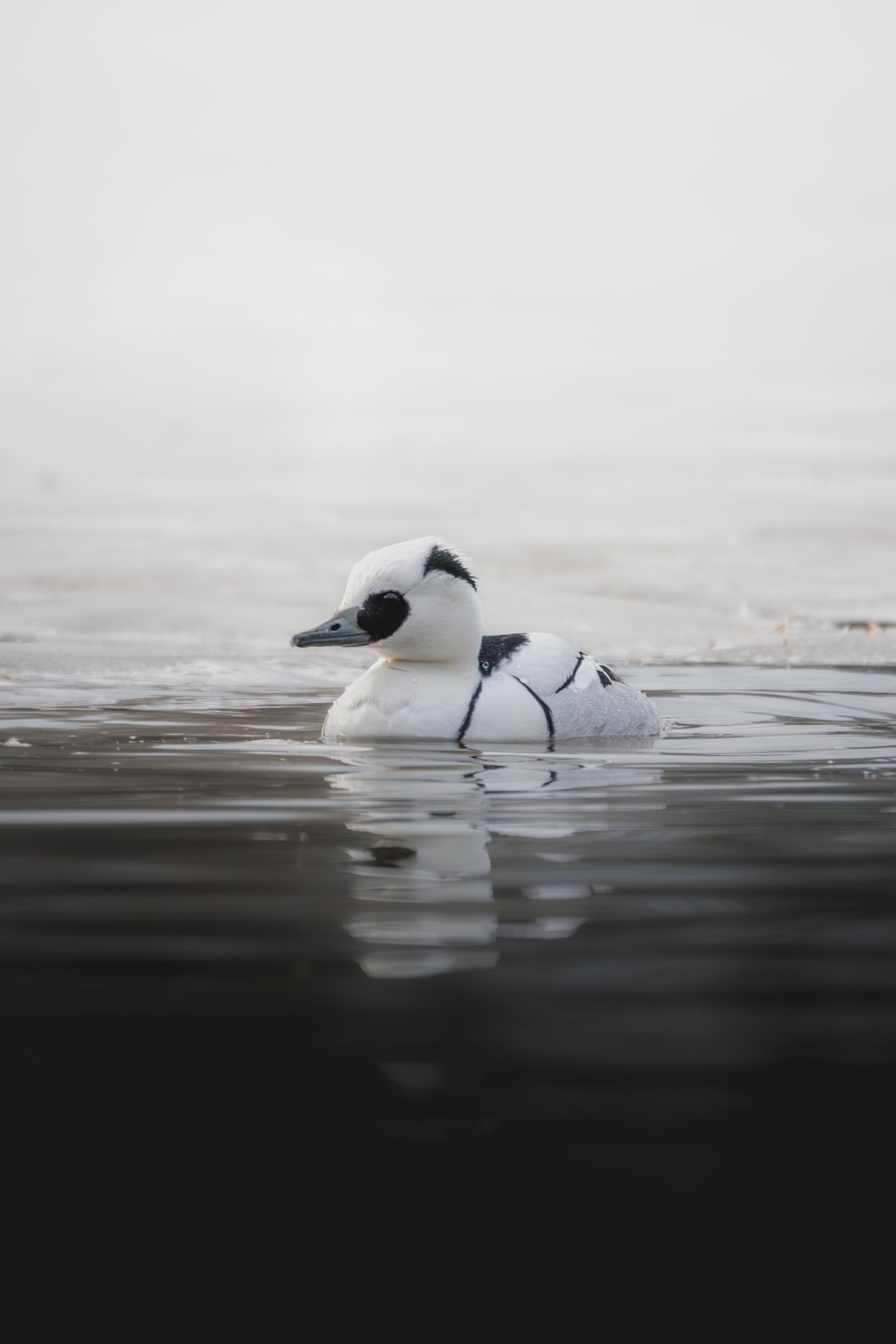
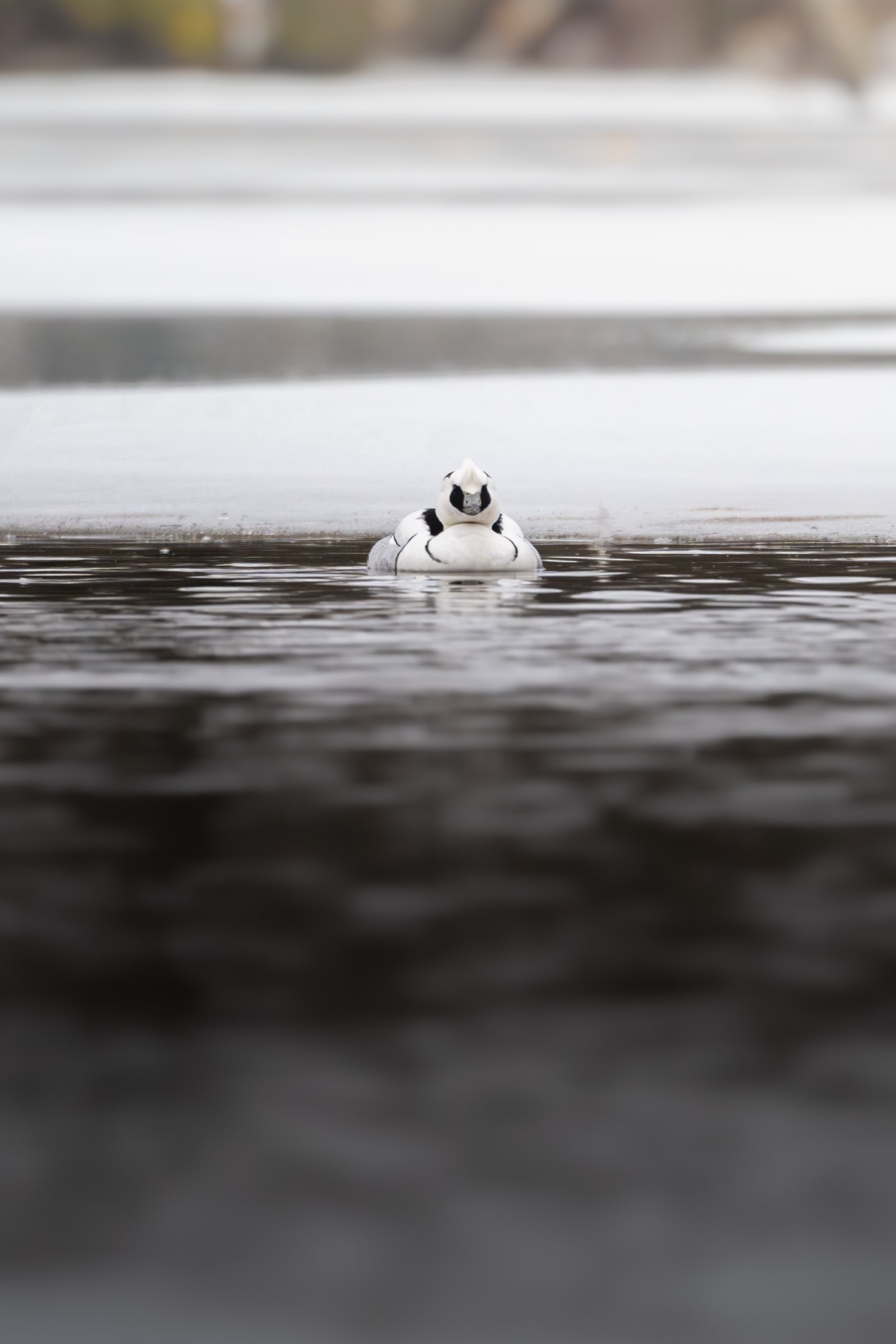
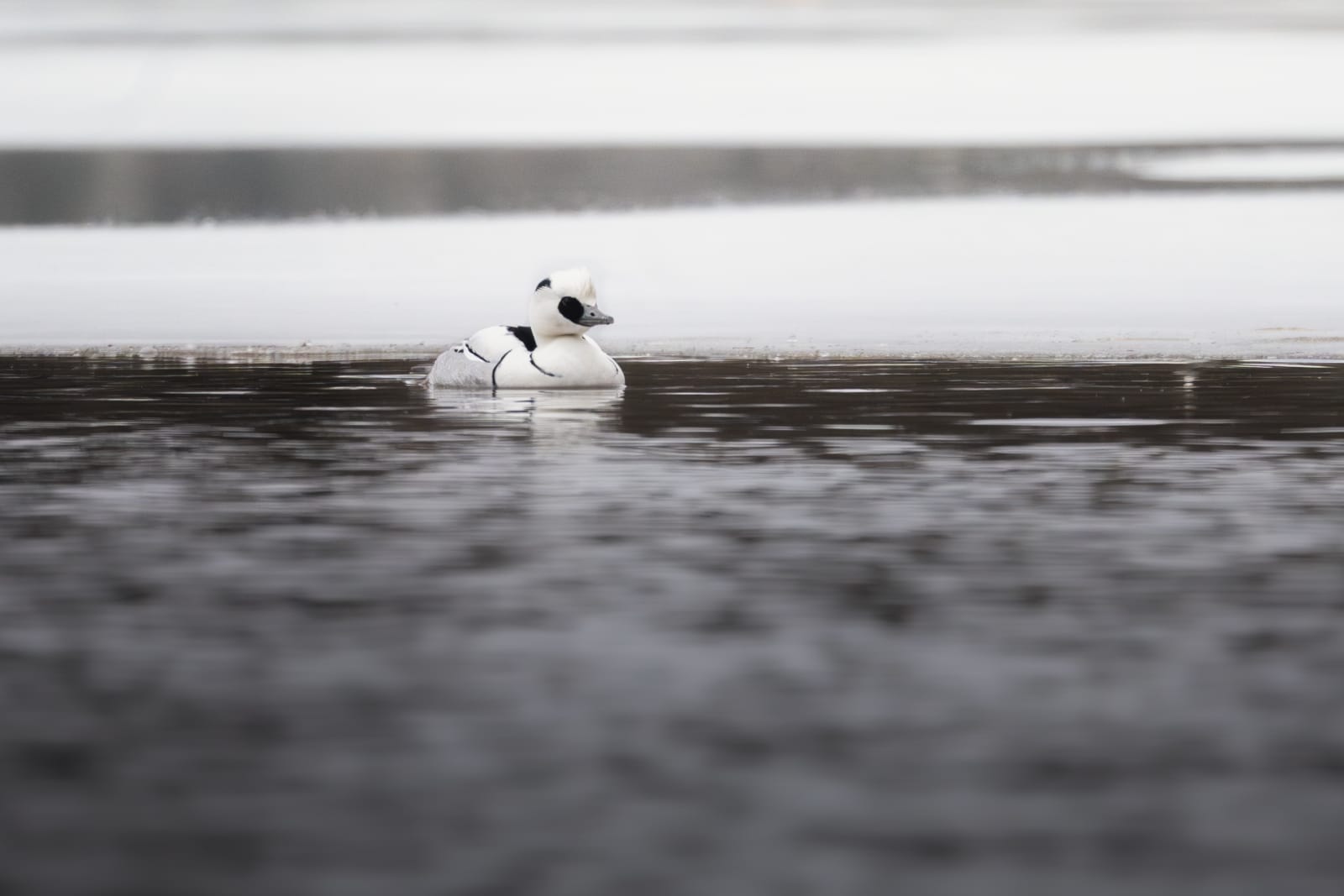
            <p>This winter Oslo had a rare visitor at one of its lakes, a male smew, and for a while he must have been the most photographed guy in town.</p>
<p>And just like many others I also made the trip to Østensjøvannet a few times to photograph this stunning black and white duck.</p>

          
            <div class="size-s">
<p>Smews (Mergellus albellus, or <span lang="no-nb"><em>Lappfiskand</em></span> in norwegian) are a small type of diving duck, that's quite rare to Norway. According to BirdLife, <a href="https://snl.no/lappfiskand#:~:text=Lappfiskand%20har%20hatt%20en%20positiv,35%20og%2065%20hekkende%20par.">there are between 35 and 65 breeding pairs</a>. They breed in the arctic and are not common around Oslo at all, so having one stop by the local lake for a few weeks was quite exciting.</p>
<p><strong>Østensjøvannet</strong> is a nature reserve located on just a ten minute drive from the city center of Oslo (or fourty minutes when using public transport), where many different types of waterbirds can be found almost all year round.</p>
<p>During winter the majority of the lake was frozen, and only one small patch of water was accessible to the birds, which happened to be right next to one of the bird watching platforms.</p>
<p>With parking (and a bus stopping) right next to the lake, a path that's easy to walk or use a wheelchair on, and a viewing platform with benches, the otherwise rather shy smew was quite accessible to observe at Østensjø.</p>
  </div>
<div class="collection-photos container size-l">
<div class="collection-grid" data-stretch="stretch" data-size="" data-type="medium" data-alignment="center" data-shape="normal" data-stretch="">
<div>
<a href="/photos/catalog/2024-03-01-smew/smew-5/">
<img class="main-image" src="https://res.cloudinary.com/dy8r02i02/image/upload/f_auto,w_1900,c_scale/DSC05255-Enhanced-NR-2_fgz9eu" alt="Small white duck with black eyes and black stripes on the body, swimming in dark gray water, with white ice in the background." />
</a>
</div>
<div>
<a href="/photos/catalog/2024-03-01-smew/smew-4/">
<img class="main-image" src="https://res.cloudinary.com/dy8r02i02/image/upload/f_auto,w_1900,c_scale/DSC05260-Enhanced-NR-2_xcmtg8" alt="Small white duck with black eyes and black stripes on the body, swimming in dark gray water, with white ice in the background." />
</a>
</div>
</div>
</div>
  <div class="container size-s">
<p>The shadow of the trees gave the water a rather dark color, almost black, which contrasted quite nicely with the white ice around it, and matched with the plumage of the smew.</p>
<p>I would have loved to photograph him during the golden morning or evening light, but never had the opportunity to visit the lake at the right time for that. So instead, I decided to focus on the contrasts and the fact that the pictures were almost naturally entirely black and white.</p>
  </div>
  <div class="size-m">
<div class="collection-photos container size-l">
<div class="collection-grid" data-stretch="stretch" data-size="" data-type="full" data-alignment="center" data-shape="normal" data-stretch="">
<div>
<a href="/photos/catalog/2024-03-01-smew/smew-3/">
<img class="main-image" src="https://res.cloudinary.com/dy8r02i02/image/upload/f_auto,w_1900,c_scale/DSC05776-Enhanced-NR_lcjupf" alt="Small white duck with black eyes and black stripes on the body, swimming in dark gray water, with white ice in the background." />
</a>
</div>
</div>
</div>
  </div>
  <div class="size-m">
<div class="collection-photos container size-l">
<div class="collection-grid" data-stretch="stretch" data-size="" data-type="medium" data-alignment="center" data-shape="square" data-stretch="">
<div>
<a href="/photos/catalog/2024-03-01-smew/smew-1/">
<img class="main-image" src="https://res.cloudinary.com/dy8r02i02/image/upload/f_auto,w_1900,c_scale/DSC05804-Enhanced-NR_apq3zl" alt="Small white duck with black eyes and black stripes on the body, swimming in dark gray water, with white ice in the background." />
</a>
</div>
<div>
<a href="/photos/catalog/2024-03-01-smew/smew-2/">
<img class="main-image" src="https://res.cloudinary.com/dy8r02i02/image/upload/f_auto,w_1900,c_scale/DSC05774-Enhanced-NR-3_hilidv" alt="Small white duck with black eyes and black stripes on the body, swimming in dark gray water, with white ice in the background." />
</a>
</div>
</div>
</div>
  </div>
  <div class="container size-s">
<p>Mr. Smew was often observed together with the common goldeneyes, even courting their females.</p>
<p>Hybrids between smews and goldeneyes do occur, and such a hybrid is occasionally observed elsewhere in the greater-Oslo area (Tyrifjorden), but I'm uncertain if the smew at Østensjøvannet got successful with any of the common eyes.</p>
<p>He arrived sometime in February and left in March, probably making his way to the north of the country. I regret not spending even more time at the lake with him before he left, they're truly beautiful birds. But I did end up with <em>a lot</em> of pictures of him, and who knows, maybe he'll stop by again next year?</p>
  </div>

        ]]>
      </content>
    </entry>
  
</feed>